
Unspoken expectations become resentments when one person treats an assumption as though it were an agreement. The answer is not to expect nothing from people. It is to distinguish a genuine need from a preference or an unstated rule, then discuss the important things plainly.
This matters in romantic relationships, friendships and families. You may feel hurt because your partner did not call after work, your friend did not show up in the way you hoped, or a sibling left all the organising to you. The other person may be equally confused: “I did not know you expected that.” Neither reaction automatically makes someone uncaring.
Disappointment often carries more weight than the event itself. A late reply can mean “I am not important to you.” Untidy dishes can mean “I am carrying this home alone.” Missing a festival gathering can mean “You do not respect my family.” Those meanings may be understandable, but they need to be spoken rather than silently assumed.
Name the expectation hiding inside the hurt
A useful starting sentence is: “I thought you would…” Finish it as specifically as possible. Not “I thought you would care more,” but “I thought you would ask how my interview went that evening.” Specificity turns a painful, vague feeling into something another person can understand and respond to.
Then identify the attached meaning. Perhaps being asked about the interview represents encouragement to you. Perhaps it is a family habit: in your home, people always checked in after an important day. The behaviour is small; the value behind it may not be.
Expectations can come from upbringing, culture, previous relationships, personal values and current stress. That does not make them unreasonable. It does mean another person may not share them automatically. Research with first-time-parent couples found that experiences falling below partner expectations were associated with lower relationship satisfaction; more benign explanations of a partner’s behaviour were linked with better outcomes. The setting was limited, but the practical lesson is broadly useful: ask about context before deciding that disappointment proves bad intent. Read the study.
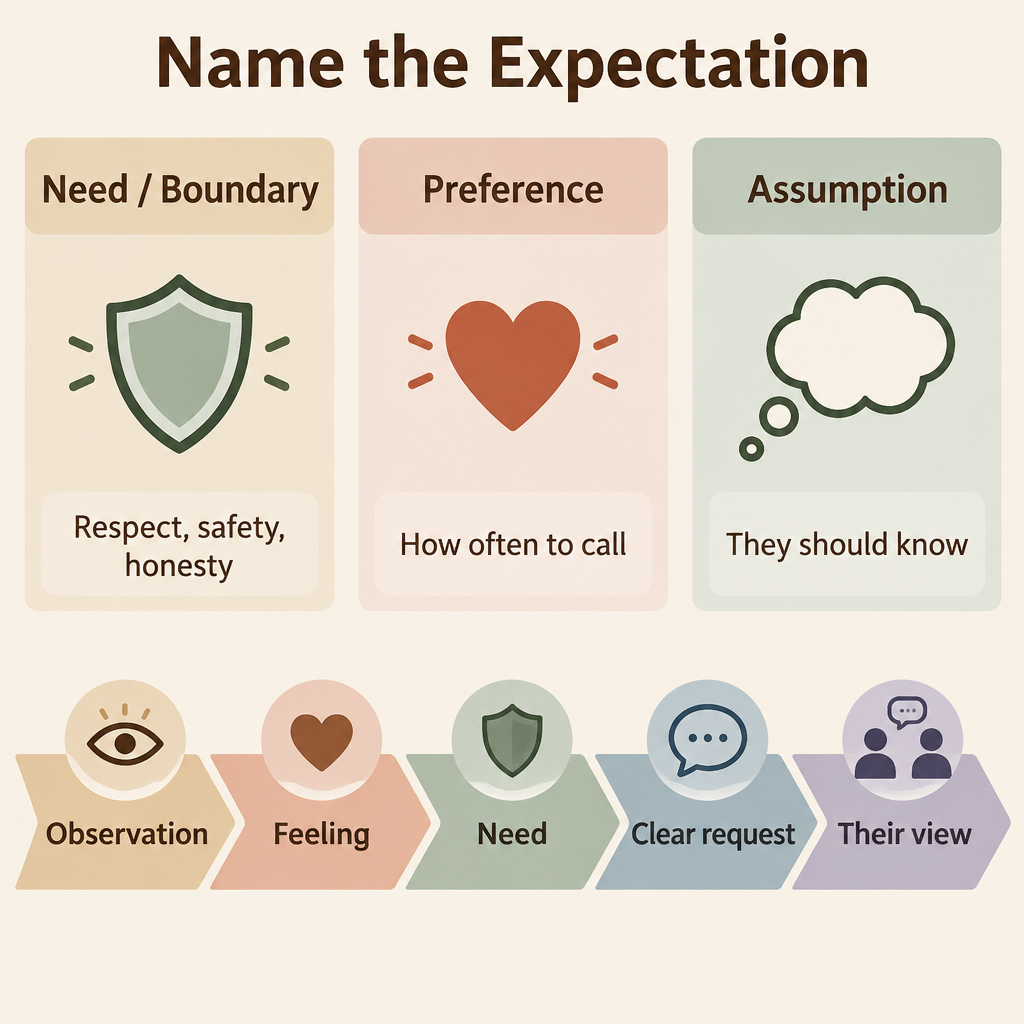
Sort needs, preferences and assumptions
Not every expectation deserves the same response. Sorting it first helps you speak with both honesty and proportion.
| Type | What it means | Everyday example | Helpful response |
|---|---|---|---|
| Need or boundary | Necessary for dignity, safety, trust or basic fairness | No insults during arguments; honesty about shared money | State it clearly and decide what you will do if it is repeatedly violated. |
| Preference | A meaningful wish with room for different styles | A good-morning message; celebrating a birthday in a particular way | Make a direct request and negotiate a realistic arrangement. |
| Assumption | A rule you expected the other person to know without discussion | They should automatically visit your parents every weekend. | Explain its meaning, ask their view and do not treat it as a broken promise. |
Respect, safety and honesty are not minor preferences. At the same time, a preference does not become a boundary simply because it is deeply felt. Calling every day may matter greatly to you, but it still requires a conversation if the other person has not agreed to it.
Have a conversation that does not invite defensiveness
Raise the issue when neither person is already overwhelmed. Focus on one recent pattern rather than bringing out a long record of failures. A calm structure can keep the discussion from becoming a verdict on someone’s character.
- Describe the observation: “This week, I cooked dinner on four evenings and cleaned up afterwards.”
- Name the feeling: “I felt tired and taken for granted.”
- Explain the need or value: “I need the home work to feel shared.”
- Make a clear request: “Can we decide in advance who cooks and who cleans on weekdays?”
- Invite their view: “What feels fair and manageable to you?”
This is different from saying, “You never help.” The first approach gives the other person useful information and a way to participate in the solution. The second may be emotionally understandable, but it usually invites an argument about whether “never” is true.
Turn common disappointments into workable agreements
Replies to messages
One person may see delayed replies as normal during work or study; another may experience silence as distance. Instead of demanding constant availability, agree on what is realistic. For example: “If one of us is busy all day, can we send a short message by evening to say we are okay?” This respects both connection and independence.
Emotional support after a difficult day
“Support me” can mean listening quietly, asking questions, offering advice, giving a hug, or leaving someone space. Say which one you need in the moment: “I do not need solutions right now; I need ten minutes to talk.” Also ask what the other person can offer then. Care has limits when someone is exhausted, unwell or handling their own crisis.
Relatives, celebrations and money
These subjects often carry family tradition and identity, which makes assumptions especially risky. Discuss details before the pressure builds: Which events are important? How often will visits happen? What is the budget? Who will communicate with relatives? A plan does not remove every difficult feeling, but it prevents one person from quietly carrying an entire expectation.
Make the agreement observable. “Help more” is too vague. “You handle grocery shopping on Saturday, and I will cook twice during the week” can be reviewed. If circumstances change, revise the agreement rather than treating any adjustment as a moral failure.
Do not choose between silence and mind-reading
There are two unhelpful extremes. One is to swallow every disappointment and tell yourself you should not need anything. The other is to believe that love, friendship or family duty should make your needs obvious. Healthy closeness asks for something more demanding: clear speech, careful listening and some flexibility from everyone involved.
Positive expectations are not automatically harmful. A study of newly married couples found that their effect differed with the quality of the couple’s interaction: positive expectations were linked with more stable satisfaction where interaction skills were stronger, but with steeper declines where those skills were weaker. In other words, hoping for good things works best alongside respectful, practical communication, not instead of it. Read the study abstract.
Know when it is more than an expectation gap
Some problems cannot be solved by phrasing a request more gently. Repeated contempt, intimidation, coercion, dishonesty, threats, or disregard for clearly stated boundaries are not ordinary misunderstandings. In those situations, focus on safety, firm limits and appropriate support from trusted people or local professional services rather than trying to negotiate closeness alone.
A short check before the next conversation
- What exactly did I expect to happen?
- Did the other person ever agree to it?
- Is this a basic need, a preference or an assumption?
- What value or fear is attached to it?
- What specific request can I make?
- What compromise would still feel respectful to both of us?
Resentment often grows in the space between what we hoped for and what we were willing to say. Closing that space does not guarantee agreement, but it gives the relationship a fairer chance to respond to the real issue.