
Saying no feels hard when another person’s disappointment seems more urgent than your own capacity. You may agree before you have even considered whether you have the time, energy, money, or desire to do what is being asked. Then the yes that kept the moment peaceful can leave you drained, irritated, or quietly resentful.
The useful goal is not to become cold or refuse every request. It is to make your yes voluntary. Kindness is a choice; people pleasing feels like a requirement for being liked, safe, or seen as a good person.
A simple warning sign is this: you say yes while hoping the request will somehow disappear. Another is agreeing outwardly and feeling angry with the other person later, even though you did not tell them your real limit.
Why an automatic yes can feel safer
There is no single reason people struggle to refuse. Some grew up learning that being agreeable prevented conflict. Some fear being judged as selfish or unreliable. Low self-esteem can also make it harder to treat one’s own needs as legitimate; NHS guidance on self-esteem specifically includes learning to be more assertive and says it is okay to say no. Read the NHS guidance.
Often, the mind predicts a severe reaction: “They will be hurt,” “They will stop inviting me,” or “They will think I do not care.” Research on declining enjoyable social invitations suggests people can overestimate the offence or relationship damage a refusal will cause. That does not mean every request is easy to decline, but it is a reason to question the prediction rather than accept it as fact. See the study summary.
Not every reluctant yes is people pleasing. A family obligation, a workplace power difference, financial dependence, caregiving, or a cultural expectation can make refusal genuinely complicated. In those situations, a boundary may need to be smaller, more private, or negotiated over time. Safety and practical consequences matter.
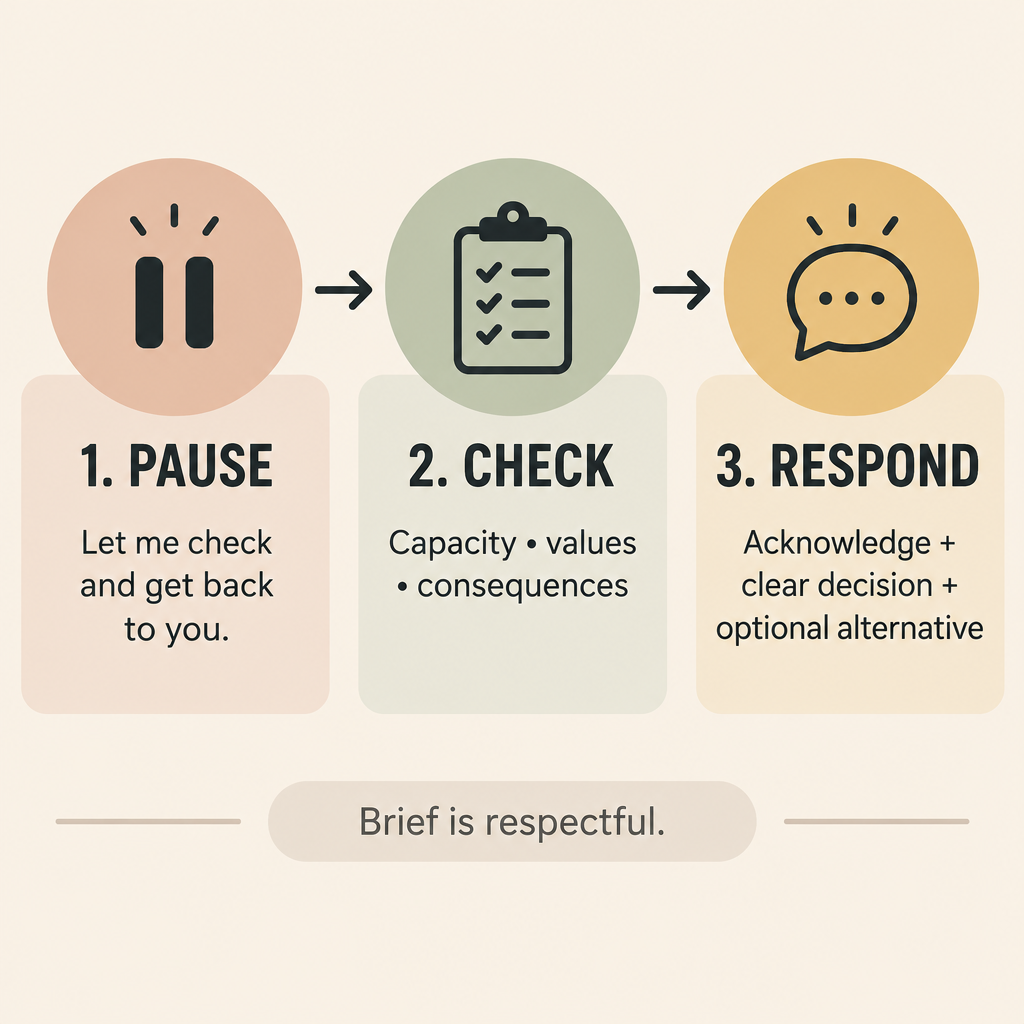
Use a pause before you answer
The most practical change is to stop treating every request as an emergency. A pause interrupts the habit of agreeing simply to end discomfort. It gives you time to check both your values and your actual limits.
- “Let me check my schedule and get back to you.”
- “I need to think about that before I commit.”
- “I cannot answer right now, but I will let you know by tomorrow.”
During the pause, ask: Do I genuinely want to do this? What will it cost in time, energy, or money? If I say yes, will I later feel trapped? Am I choosing this freely, or trying to avoid someone’s reaction?
A pause is not a promise that you will eventually agree. It is space to give an honest answer.
Make the answer brief and clear
A respectful boundary usually needs three parts: acknowledgement, decision, and an alternative only if you truly want to offer one. The alternative is optional. Offering it out of guilt can turn a no into a different unwanted yes.
| Situation | Short response |
|---|---|
| An invitation | “Thank you for inviting me. I will not be able to make it this time.” |
| Extra work | “I cannot take that on this week. I can discuss priorities if this needs to be moved forward.” |
| A family request | “I understand this matters to you. I am not able to do that.” |
| A repeated favour | “I cannot help with this today. Please make another arrangement.” |
Notice what these replies do not contain: a long defence. Explaining every detail may feel polite, but it can invite the other person to debate each reason. “You are tired” can become “It will only take an hour.” “You have plans” can become “Cancel them.” A short explanation is fine when it helps the relationship, but it is not a permission slip the other person must approve.
When someone keeps pushing
You do not need a smarter argument to hold a boundary. Calm repetition is often enough: “I know it is inconvenient, but I cannot do it.” Then stop adding new reasons. If the person is disappointed, you can acknowledge that feeling without taking responsibility for fixing it: “I understand you are disappointed.”
This approach is not about winning. It prevents a conversation from becoming a negotiation over whether your limit is valid. Guidance from the American Psychological Association recommends pausing before agreeing and practising boundary language, which can make a response easier to use in the moment. Read the APA discussion of boundary practice.
What to do with the guilt afterwards
Guilt after saying no is common, especially if you are changing a long-standing habit. But guilt is a feeling, not automatic evidence that you have done something wrong. Before reversing your answer, check the facts.
- Was the request unreasonable, urgent, or simply inconvenient for the other person?
- Did you have the capacity to help without harming your health, responsibilities, or peace of mind?
- Would you expect a friend to agree under the same conditions?
- Does this relationship allow both people to have limits?
A healthy relationship may include disappointment, compromise, and occasional help during difficult times. It should not require one person to be endlessly available. If you always agree to avoid a conflict, the other person receives a version of you that is agreeable but not fully honest. Over time, that can damage closeness more than a respectful refusal would.
Start with a small no
Do not begin with the most emotionally loaded relationship in your life. Practise on low-stakes requests: declining an optional call, choosing a quieter weekend, or saying you cannot respond immediately. The aim is not to become rigid. It is to learn that another person can be mildly disappointed and the relationship can still be okay.
If fear of judgement or rejection is intense, persistent, and leads you to avoid ordinary work, relationships, or daily activities, it may be worth speaking with a qualified mental-health professional. Persistent fear of negative evaluation can be associated with social anxiety, but people pleasing by itself is not a diagnosis. NIMH explains when social anxiety becomes more than shyness.
A respectful no protects your energy, but it also protects honesty. You do not have to over-explain your limits to make them real. The people who care about you may not always like your answer, yet they can still learn where you stand.