
It can be hard to accept help because help is rarely only about the task. A lift home, a meal, money, childcare, or a listening ear can stir up worries about being a burden, losing control, being judged, or owing someone more than you can repay. Feeling uneasy does not mean you are ungrateful.
Healthy independence means making your own choices and managing what you can. Isolation is different: it means refusing support even when the cost of doing everything alone is becoming too high. Accepting a limited, respectful offer does not cancel your independence. It lets another person contribute to a relationship that is meant to have room for both giving and receiving.
Research with people receiving ongoing informal care has found recurring concerns about shame, self-reliance, burdening others, and upsetting the usual give-and-take in close relationships. Those findings come from a specific care context, but they help explain why an ordinary offer can carry emotional weight. The study is available through PubMed Central.
What makes receiving help feel difficult
The hardest part is often the meaning attached to help, not the help itself. Someone may welcome a friend bringing soup but feel uncomfortable if the friend starts deciding what they should eat, whom they should call, or how they should solve their life. Support feels safer when the receiver remains a person with choices, not a problem to be managed.
- “I should handle this myself.” Self-reliance may be a deeply held value, or something learned when support was unreliable in the past.
- “I will become a burden.” People may overestimate how resentful others will feel, especially when they are used to being the dependable one.
- “I will owe them.” An offer can feel like a hidden contract if help has previously been used as leverage.
- “They will see me differently.” Needing support can expose private struggles and challenge the image a person wants to maintain.
- “This will never end.” A small favour may feel risky when someone fears it will turn into an open-ended dependency.
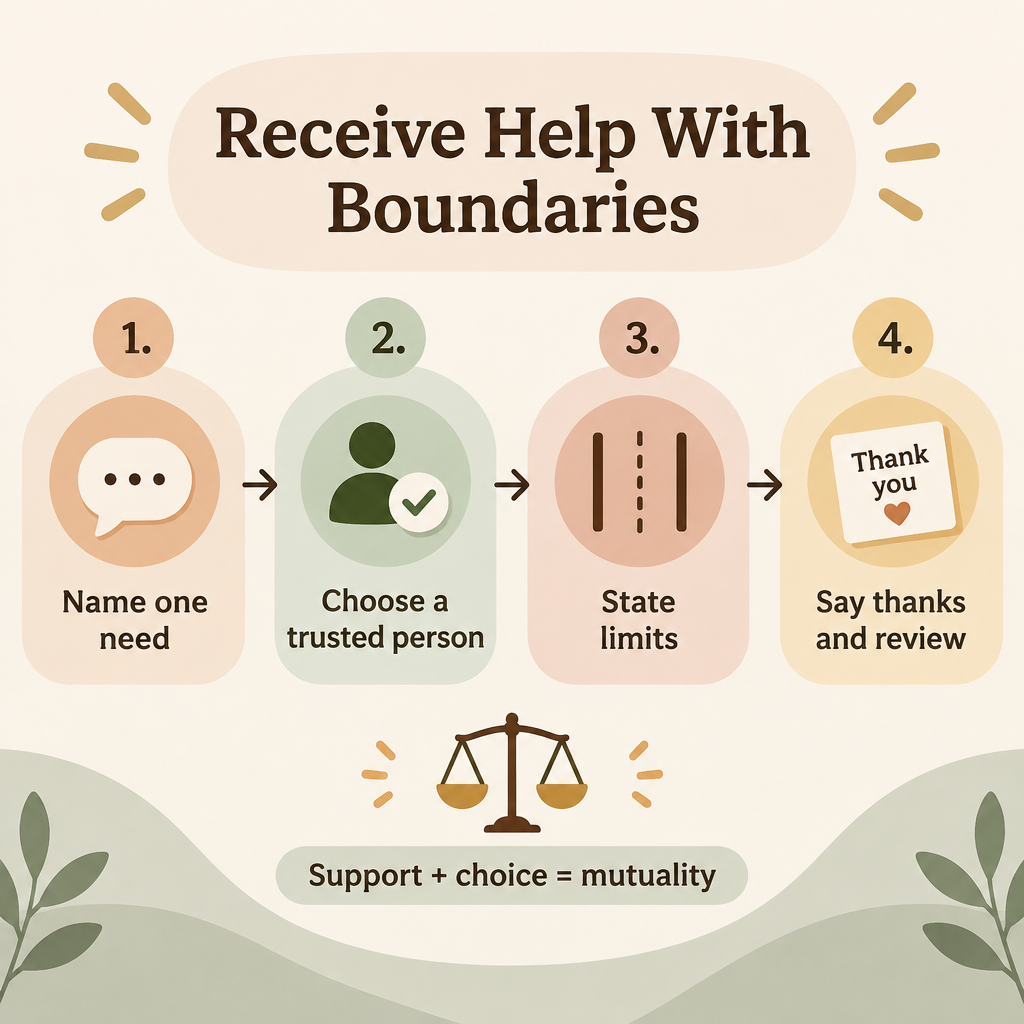
Support does not have to mean surrendering control
There is a useful middle ground between refusing everything and handing over your decisions. You can accept help with a clear scope. “Could you pick up my child from school on Thursday?” is different from “Please take over whenever things get difficult.” “I need you to listen for ten minutes, not fix it” is a real request with a boundary.
Consider a hypothetical example. An adult child is recovering from an illness and their parent offers to stay for a month. The offer may be loving, yet a month may feel intrusive. A more workable response could be: “Thank you. I would be comfortable with you staying this weekend and helping with groceries. After that, I want to see how I manage.” Gratitude and limits can exist in the same sentence.
Family and friendship can make this especially delicate because people want to preserve dignity and reciprocity. The balance does not always have to be immediate or identical. A friend who drives you to an appointment may later value your encouragement, your time, or simply the trust you placed in them. Relationships are not healthiest when every kindness is calculated like a bill.
A low-pressure way to say yes
- Name one concrete need. Ask for a meal, a ride, a short call, help carrying something, or company at an appointment. Specific requests are easier for both people to understand.
- Choose the right person. Pick someone who has shown discretion, reliability, and respect for your decisions. The nearest person is not always the safest person to ask.
- Set the limits upfront. Say what would help, when it would end, and what you do not want. For example: “A call this evening would help, but I do not want advice right now.”
- Accept the answer honestly. Give the other person room to decline or offer a different form of help. A genuine request is not a demand.
- Say thank you without apologising repeatedly. “Thank you, that made today easier” recognises their effort. Repeated apologies can make a kind exchange feel like a burden to both sides.
- Review the arrangement. If help becomes uncomfortable, say so early: “I appreciate this, but I would prefer to handle the rest myself.”
Culture can shape the discomfort, but it does not define everyone
In some families and communities, mutual practical support is expected and freely offered. In others, privacy and self-sufficiency are strongly prized. People may also worry that directly asking for emotional support will disrupt harmony or place pressure on the other person. These are tendencies, not rules about any nationality, family, or individual. Cultural research on social support points to meaningful differences in how requested and unrequested support can be experienced, which is one reason it is better to ask rather than assume. Read the research discussion here.
A respectful approach is simple: make the request clear, let the other person choose, and do not treat reluctance as a character flaw. Someone may prefer practical help to emotional conversation, or the other way around.
If you are the person offering help
Good intentions are not enough if the offer leaves the other person feeling cornered. Start with permission: “Would it help if I brought dinner?” or “Do you want advice, help with a task, or just someone to hear you out?” A choice is often more supportive than a broad promise to “do anything.”
- Ask before stepping in or sharing someone’s private situation.
- Offer options rather than taking charge.
- Listen before giving advice, and avoid rushing them to feel better.
- Keep the help proportionate to what was requested.
- Do not mention your help later to win an argument, demand access, or create guilt.
Practical guidance on supporting people after difficult events similarly emphasises attention, non-judgement, listening, and avoiding pressure to “get over it.” The NIEHS factsheet explains these supportive practices.
Know when an offer is not safe to accept
Not all help is healthy. Be cautious when a person makes their support conditional on obedience, isolates you from others, demands personal information, ignores your limits, or repeatedly reminds you of what you “owe.” In a controlling or abusive situation, it may be safer to speak with a trusted person outside that relationship or contact an appropriate local support service.
Receiving help well is not about becoming dependent or pretending every offer is safe. It is about recognising a reasonable offer, choosing the terms that protect your dignity, and allowing care to move in both directions. Sometimes the most self-respecting answer is a clear, bounded “yes, thank you.”