
Accepting money, housing, or practical help from family does not automatically mean you have surrendered every personal choice. But support can become emotionally costly when nobody says clearly what is expected in return. The healthiest starting point is not independence at any cost; it is clarity before resentment.
Family help can be an expression of love, duty, sacrifice, worry, or a wish to stay connected. It can also create a real imbalance: the person providing support may feel entitled to more influence, while the person receiving it may feel unable to disagree. Neither feeling automatically makes someone bad. The problem usually begins when gratitude is treated as permanent obedience.
Support between parents and adult children is often more complex than a simple one-way dependency. It may change over time and can include money, housing, care, and practical help in both directions. A study of adult parent-child exchanges describes this support as varied and sometimes long-running, which is one reason families benefit from discussing it openly rather than relying on assumptions. Read the study.
The question to ask before accepting help
Ask: “What does this support mean to each of us?” Do not assume that an offer is either a gift with no conditions or a contract that gives the family control over everything. Find out.
- What exactly is being offered: rent, tuition, food, a loan, childcare, or temporary housing?
- Is it a gift, a loan, or an arrangement with shared responsibilities?
- How long is the support expected to continue?
- What contribution can you make now, financially or practically?
- Which decisions are shared because you live together, and which remain personal?
These questions are not rude or ungrateful. They give everyone a chance to consent to the arrangement as adults.
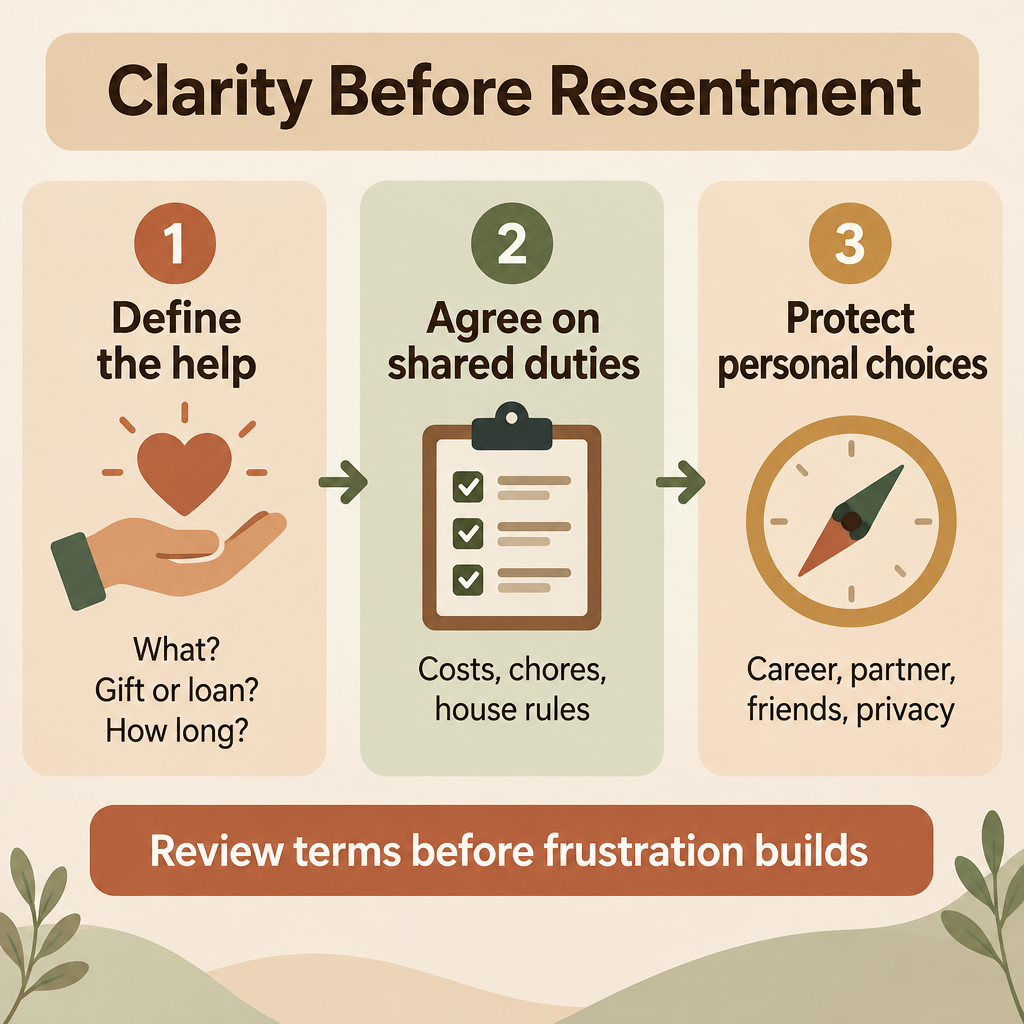
Reasonable expectations versus control
Living in a family home or using family money can reasonably involve obligations. If others are paying the bills or sharing the space, your choices affect them too. Respecting household routines, helping with chores, contributing what you can, and agreeing on visitors or quiet hours are ordinary parts of shared living.
Control is different. It is when help is used to claim authority over areas that properly belong to an adult, such as whom they date or marry, what career they choose, which friends they see, their personal beliefs, or every movement outside the house. Families may have strong opinions about these choices. An opinion is not the same as a right to decide.
| Often reasonable to discuss together | Usually a personal adult choice |
|---|---|
| Chores, shared expenses, guests, noise, and use of shared space | Career direction, partner choice, friendships, beliefs, and private communications |
| A repayment plan when money is clearly a loan | Agreeing to a life plan simply to prove gratitude |
| A review date for temporary support | Unlimited access to your phone, accounts, or whereabouts |
There can be grey areas. For example, a parent may reasonably want to know whether a major financial decision will affect their loan, home, or savings. That does not mean they should make the decision alone. The aim is to separate legitimate shared consequences from personal control.
Have the clarity-before-resentment conversation
Raise the subject early, ideally before accepting the help or before frustration has built up. Choose a calm time rather than bringing it up during an argument. Speak in specifics. “Please do not interfere” is easy to misunderstand; a clear request is easier to respond to.
You might say: “I am grateful that you are offering to help with my rent while I look for steadier work. I want us to avoid misunderstandings. Can we talk about how long this support will last, what I can contribute at home, and which decisions I will continue to make for myself? I will listen to your advice about my career, but I need the final choice to be mine.”
This script does four useful things: it recognises the help, avoids accusation, asks for concrete terms, and names a boundary without insulting the other person.
Turn a vague offer into a workable agreement
You do not need a legal-style document for every family arrangement. A short shared note or a clear verbal agreement can be enough. What matters is that both sides understand the same arrangement.
- Support: State the amount, bill, room, or service being provided.
- Duration: Choose an end date or a date to review the arrangement.
- Contribution: Name rent, groceries, chores, caregiving, or other practical help you can offer.
- Household rules: Agree on matters that affect everyone sharing the home.
- Privacy: Clarify expectations about rooms, messages, visitors, and personal information.
- Decision-making: Identify choices that need discussion because they affect the household, and choices that remain yours.
- Changes: Agree that either person can raise a problem before ending the arrangement in anger.
A timeline can make support feel less like an unspoken debt. Research on parental help during young adulthood also suggests that assistance often changes as needs and adult roles change; that is a reason to review an arrangement, not a rule that support must end at a particular age. See the research.
When family values and personal choices differ
In many families, mutual support across generations is normal and deeply valued. Adult independence does not have to mean emotional distance or refusing all help. At the same time, closeness works best when it includes respect for adult consent. A family can value consultation, duty, and togetherness without making one person’s future conditional on obedience.
If relatives strongly oppose a choice, try not to make promises just to end the conversation. A more honest response is: “I understand this worries you. I need time to think, and I cannot agree to that condition today.” It may feel less satisfying than a dramatic confrontation, but it prevents a temporary escape from becoming a deeper conflict later.
If the terms feel too restrictive
Sometimes the clearest boundary is changing the financial arrangement. That does not have to mean cutting off a relationship. Consider accepting a smaller amount, paying one specific expense yourself, setting a move-out or repayment plan, contributing through work at home, or delaying a decision until you have other options. A modest increase in financial independence can create more room for calm conversation.
Be realistic about risk. Do not reject essential housing, food, education, or medical support in the heat of an argument without a safe alternative. If possible, quietly understand your budget, documents, transport, trusted contacts, and other sources of support before taking a major step.
Know when this is more than a family disagreement
Ordinary conflict becomes more serious when money is paired with threats, humiliation, forced isolation, monitoring, pressure to hand over earnings or accounts, or punishment for refusing a demand. These behaviours can be signs of coercion or financial abuse. In that situation, focus first on safety and confidential support from a trusted local service, counsellor, legal adviser, or domestic abuse resource where appropriate.
Gratitude and self-direction can exist together. Thanking family for support does not require pretending you have no right to a private life or a future of your own. Clear terms, honest limits, and regular review protect relationships far better than silent obligation.