
Emotional detachment is not automatically unhealthy. Sometimes the most responsible thing a person can do is pause before saying something cruel, making a rushed decision, or continuing an argument while overwhelmed. The important question is not, “Do I need space?” but, “What does this space make possible next?”
Healthy space creates enough calm for a more honest return to the relationship. Shutting someone out creates more uncertainty, resentment, and distance. One is a pause with a purpose; the other is often an escape from discomfort that leaves the underlying issue untouched.
Taking space and emotional withdrawal are not the same
Taking space means stepping back temporarily to regulate yourself. You may need an evening alone after a tense conversation, a walk before replying to an upsetting message, or a day to think through a major disagreement. You are still recognising that the relationship and the conversation exist.
Emotional withdrawal is different. It can look like going silent for days without explanation, changing the subject whenever feelings arise, or acting as if needing anybody is a weakness. The person may be physically present but emotionally unavailable. This pattern does not necessarily mean they do not care; it may reflect overwhelm, fear, or old self-protective habits. But the effect on the other person can still be painful.
The distinction is usually flexibility. Research on romantic relationships has linked greater attachment avoidance with relying more heavily on self-directed rather than interpersonal ways of managing emotion. That does not make independence a problem. It suggests that difficulty arises when accepting comfort, support, or connection stops feeling like an available option. Adult Attachment and Emotion Regulation Flexibility in Romantic Relationships
You do not need to label yourself or someone else to use this idea. Simply notice whether distance is a choice you can adjust, or the only move that feels safe.
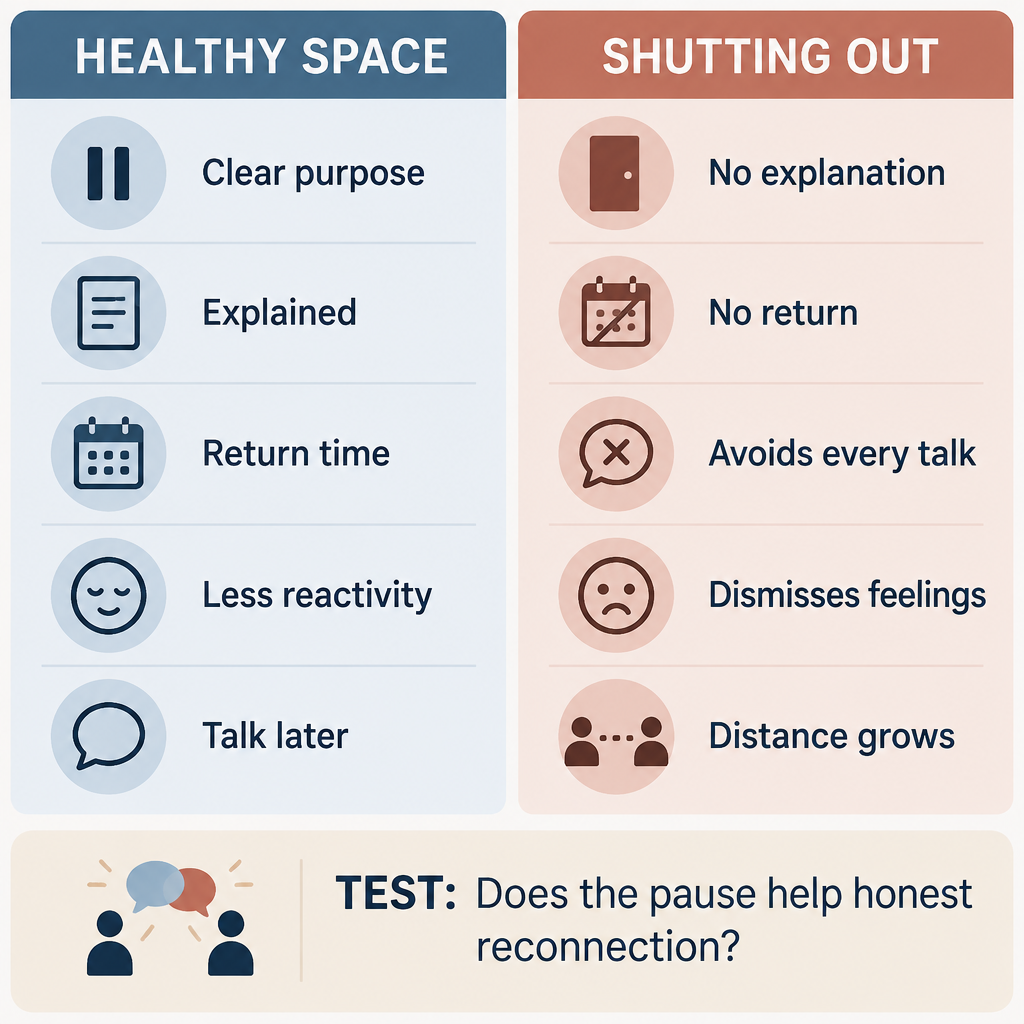
Five signs that distance is helping
- It has a clear purpose. You are trying to calm down, gather your thoughts, or avoid reacting impulsively.
- You communicate what you can. Even a short message can prevent a pause from feeling like abandonment.
- There is a return point. You name a time to check in, or you make a realistic plan to resume the conversation.
- It protects respect. The break reduces shouting, sarcasm, blame, or messages sent in anger.
- It leads to greater honesty later. After the pause, you can say what hurt, what you need, and what you are willing to do differently.
A healthy pause does not need to be perfectly managed. You may not know exactly how long you need. Still, giving a rough timeframe and following up matters. “I need tonight to settle down. Can we talk tomorrow after dinner?” is far kinder and clearer than disappearing.
Five signs you may be shutting people out
- You disappear or stop replying whenever a conversation becomes emotionally difficult.
- You refuse every attempt to discuss conflict, even after you have had time to cool down.
- You dismiss another person’s feelings as needy, dramatic, or inconvenient rather than responding to the concern itself.
- You treat total self-sufficiency as the only safe way to live, even with people who have earned some trust.
- You reconnect only after the other person gives up asking for clarity, repair, or closeness.
These signs are not a verdict on anyone’s character. They are signals that a protective strategy may now be costing more than it gives. A person can value privacy, need solitude, and still remain emotionally accountable to the people affected by their choices.
Why detachment can become a habit
People often pull away because closeness feels risky at that moment. They may fear conflict, feel ashamed of their emotions, need autonomy, or expect disappointment based on earlier relationships. Some grew up in homes where arguments became explosive, private feelings were ignored, or asking for comfort did not work. Others simply have not learned how to take a pause without cutting contact.
Understanding the reason can bring compassion, but it does not erase the impact. If silence leaves a partner, friend, or family member constantly guessing where they stand, the relationship will eventually carry that uncertainty. In studies of couples, more avoidant behaviour during problem discussions has been associated with less warmth and support; this is one reason withdrawal can feel so lonely to the person on the other side. Conflict in close relationships: an attachment perspective
A practical way to ask for space
Keep the message brief. You are not required to solve the whole conflict while overwhelmed. But include three parts: your current limit, your intention, and a return time.
- Current limit: “I am too overwhelmed to discuss this well right now.”
- Intention: “I do want to understand this and talk properly.”
- Return time: “Can we come back to it tomorrow evening?”
If tomorrow evening turns out not to work, say so before the agreed time and offer another specific option. Reliability is what turns space into a boundary rather than a form of punishment.
What to do when someone else asks for distance
It is reasonable to respect a genuine request for time. Repeated calls, long streams of messages, or demands for an immediate answer can make an overwhelmed person retreat further. At the same time, respecting space does not mean accepting indefinite uncertainty.
- Ask calmly for a specific time to reconnect: “I can give you space. When can we check in?”
- Avoid mind-reading. Silence may mean many things; ask for clarity rather than deciding it proves a lack of care.
- State the impact without accusation: “When I do not hear from you for several days after an argument, I feel shut out and lose trust in our ability to resolve things.”
- Notice the pattern over time. One difficult pause is different from a relationship where repair never happens.
- Decide what you need to remain in the relationship with self-respect. This may include regular communication, a willingness to discuss problems, or outside support.
Sometimes a small request for connection is more useful than pretending not to need anything. Research involving couples found that, in certain support discussions, reassurance-seeking by more avoidant individuals was linked with greater partner closeness and support. It is not a rule for every relationship, but it is a useful reminder that asking plainly can be more constructive than disappearing. Repairing Distance and Facilitating Support
Distance is not a solution to unsafe behaviour
If a relationship involves intimidation, coercion, threats, stalking, or abuse, a communication script is not enough. Prioritise immediate safety and seek local emergency, domestic violence, legal, or mental health support that fits your circumstances. You do not owe continued access to someone who is making you unsafe.
A simple test can help: after taking distance, are you more able to reconnect with honesty and care? If yes, the space may be serving you well. If each pause makes connection feel more impossible, it may be time to address the pattern directly. Emotional maturity is not never needing space. It is knowing how to take space without turning another person into a stranger.