
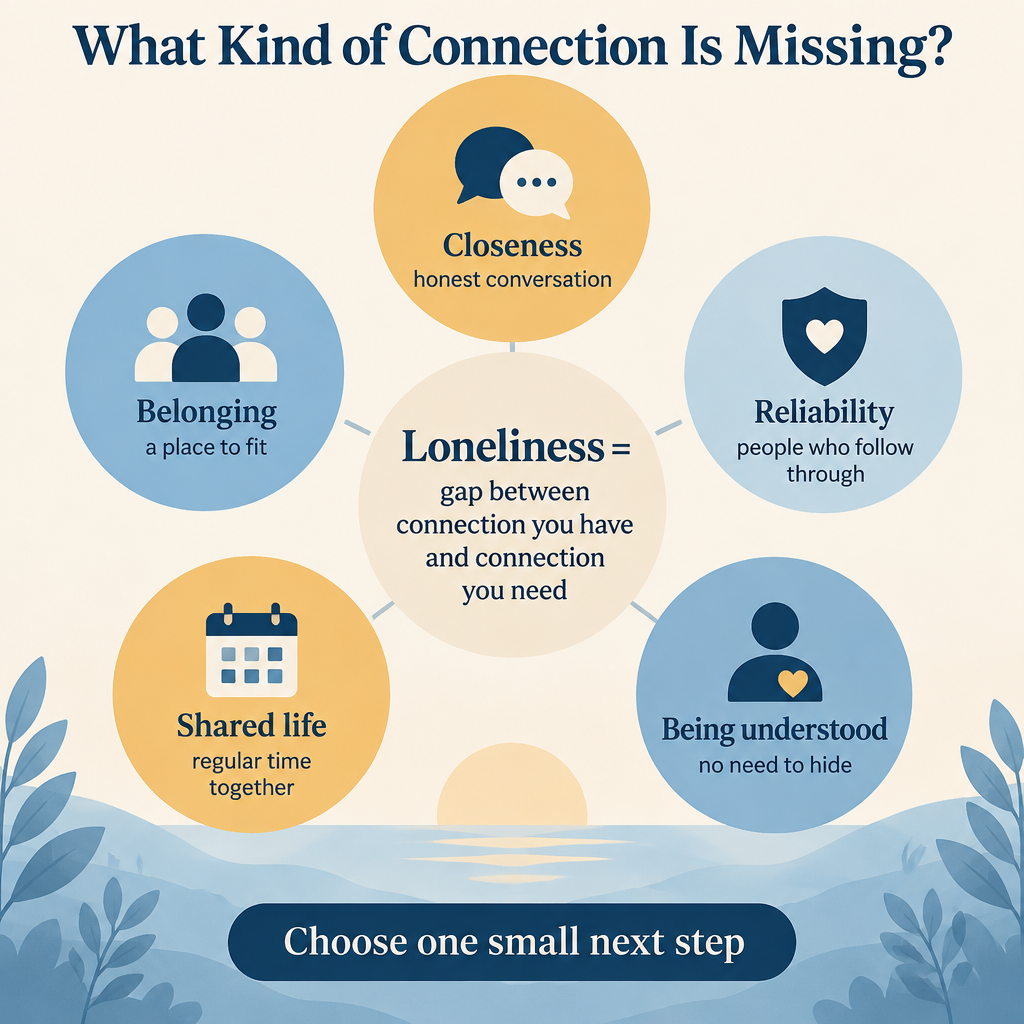
You can feel lonely in a busy home, at a crowded workplace, or in a lively group chat because company and connection are not the same thing. Loneliness is often the painful gap between the relationships available to you and the kind of connection you need at that point in life.
This is not a sign that you are ungrateful, socially incapable, or surrounded by the “wrong” people. It may mean that conversations stay on the surface, that you do not feel safe being fully yourself, or that nobody currently knows what is weighing on you.
Loneliness and social isolation are related, but different
Social isolation describes having limited relationships, contact, or support. Loneliness is the feeling of being alone or disconnected from meaningful relationships. A person can be socially isolated and not feel lonely for a period of time; another can have a full calendar and still feel deeply alone. The CDC makes this distinction and notes that having many friends does not automatically prevent loneliness. CDC: Health Effects of Social Isolation and Loneliness
There is no correct number of friends, calls, family members, or social invitations. What matters is whether you have enough of the relationships you want: relationships that offer some combination of belonging, care, reliability, and support.
First, name what feels missing
“I am lonely” can describe several different needs. Naming the need makes the next step less vague. You might be missing one trusted person for honest conversation, a shared routine with others, practical help during a hard period, a community where you feel included, or the quiet reassurance of being chosen and remembered.
- Closeness: someone with whom you can speak honestly.
- Belonging: a group, place, culture, or activity where you feel you fit.
- Reliability: people who follow through and make room for you.
- Shared life: regular meals, walks, work, hobbies, or small rituals.
- Being understood: the sense that important parts of your life do not need to be edited out.
Why loneliness can show up in a crowd
1. The interaction is frequent, but not personal
You may talk to people all day about work, children, news, tasks, or plans, yet never reach the thoughts and feelings that matter most. Pleasant small talk has value, but it cannot always meet the need to be known. This is common when life is busy or when a group has formed around a role rather than genuine friendship.
2. You are hiding important parts of yourself
People sometimes keep quiet about grief, financial pressure, relationship worries, identity, beliefs, health concerns, or disappointment because they expect judgement or do not want to burden anyone. Privacy can be wise. But if you must constantly perform a version of yourself that feels acceptable, even warm company can feel distant.
3. The relationships feel one-sided
Loneliness can grow when you are always the person who checks in, listens, organises, compromises, or travels to meet others. The issue is not that every relationship must be perfectly equal. It is that a lasting pattern of little curiosity or effort from others can leave you feeling unseen.
4. A life transition changed your social world
Moving city, working remotely, becoming a parent, ending a relationship, caring for family, changing schools, or living abroad can quietly remove the repeated contact that friendships often depend on. You may still know many people, but the old ease of seeing them may be gone. Missing a previous community is not proof that you have failed to adapt.
5. Comparison makes ordinary connection look inadequate
Social media tends to show gatherings, celebrations, affection, and milestones rather than cancelled plans, awkward pauses, or lonely evenings. Seeing other people’s visible moments can make your own relationships seem thinner than they are. The comparison is especially harsh when you are already feeling left out.
Match the response to the kind of loneliness
| What you notice | What may help most |
|---|---|
| “I have people around me, but nobody knows the real me.” | A small, careful act of honesty with a person who has shown kindness and discretion. |
| “I miss having people in my everyday life.” | An activity with regular attendance, such as a class, volunteer role, faith community, sports group, or local interest group. |
| “Nobody contacts me unless I start.” | A direct invitation to one person, while also widening your circle if the pattern continues. |
| “I feel left behind when I go online.” | Reducing comparison-triggering use and replacing some scrolling with a real interaction or restorative routine. |
| “I do not feel safe or valued in my current relationships.” | Seeking healthier spaces and support rather than trying harder to earn closeness from unavailable people. |
More contact is not always the whole answer. Research reviews have found that changes in social contact and changes in how connected people feel do not necessarily move together. That is one reason a simple instruction to “just socialise more” can miss the point. Interventions to improve social connections: a systematic review and meta-analysis
Small ways to build more meaningful connection
Do not wait to feel completely confident or suddenly become outgoing. Choose one manageable action that fits the kind of connection you miss.
- Reconnect specifically. Instead of “We should meet sometime,” try: “I have been thinking of you. Would you like to have tea or go for a walk this Saturday?” A clear plan makes it easier to say yes or no.
- Choose repeated contact over one-off events. Familiarity grows through seeing people again. Attend the same activity for several weeks before deciding whether it is a fit.
- Share one honest sentence. You do not need to reveal everything. “I have felt a bit disconnected lately” can open a more real conversation with a trustworthy person.
- Make room to receive. If you are used to being the capable one, practise letting someone help in a small way. Mutuality often deepens connection.
- Review your online habits. Notice which accounts or times of day leave you comparing. A boundary might be as simple as not scrolling when you are tired or already feeling excluded.
It is also worth being patient with the process. A good conversation can bring relief, but belonging usually develops through consistent participation, small acts of care, and time. The aim is not to collect contacts or force instant intimacy. It is to create more chances for relationships in which you can be known, supported, and included.
When extra support may be needed
Loneliness can sit alongside persistent low mood, hopelessness, anxiety, severe withdrawal, or thoughts of self-harm. If that is happening, reaching out to a qualified mental-health professional or an appropriate local crisis service is an important next step. You deserve support that does not depend on handling everything alone.
For a broader public-health view, the CDC describes social connectedness in terms of the number, quality, and variety of relationships a person wants, along with feelings of belonging, care, and support. CDC: Social Connection That is a more useful measure than whether your life looks socially busy from the outside.
Feeling lonely around people is not a contradiction. It is information: something about your current connection is not meeting a real human need. Start by identifying that need, then take one small step towards the people and places where a more genuine bond has room to grow.