
A choice is more likely to be your own when you can explain why it suits your values, needs, and circumstances—not only why it will keep other people from being upset. That does not mean every family tradition or common expectation is bad. It means you are able to see the influence clearly and decide how much weight it deserves.
A social norm is an unwritten expectation about what people usually do or what a group considers proper. The American Psychological Association distinguishes between descriptive norms (what seems typical) and injunctive norms (what people believe ought to be done). Neither is automatically a law, a moral truth, or a personal obligation. APA Dictionary of Psychology: social norm
Not every expectation means the same thing
It helps to name what you are dealing with before deciding whether to comply, negotiate, or say no. A norm can feel absolute when it is repeated by people you love, but different kinds of expectations call for different responses.
| What it may be | What it means | Useful question |
|---|---|---|
| Law or formal rule | A requirement backed by an institution or authority. | What are the actual requirements and consequences? |
| Practical convention | A shared habit that makes coordination easier. | Does this solve a real problem, or is it only familiar? |
| Family or cultural tradition | A practice that may carry identity, affection, faith, or continuity. | What does this mean to me, and what does it mean to others? |
| Personal value | A principle you would want to follow even without an audience. | Would I still stand by this privately? |
| Social pressure | An expectation maintained mainly through approval, gossip, shame, or fear of exclusion. | Am I choosing this, or trying to avoid judgement? |
For example, attending a family event may be a meaningful way to maintain relationships. Wearing a particular outfit, accepting a career path, or marrying by a certain age may be presented as equally important, yet involve much more personal choice. The point is not to rank cultures or families. It is to separate practical care and shared meaning from pressure that has never been examined.
People follow norms for more than fear of punishment. They may have absorbed a norm as part of their identity, learned it from others, or care about their social and self-image. That makes conformity understandable, not a sign of weakness. This review of why people follow social norms describes these different pathways.
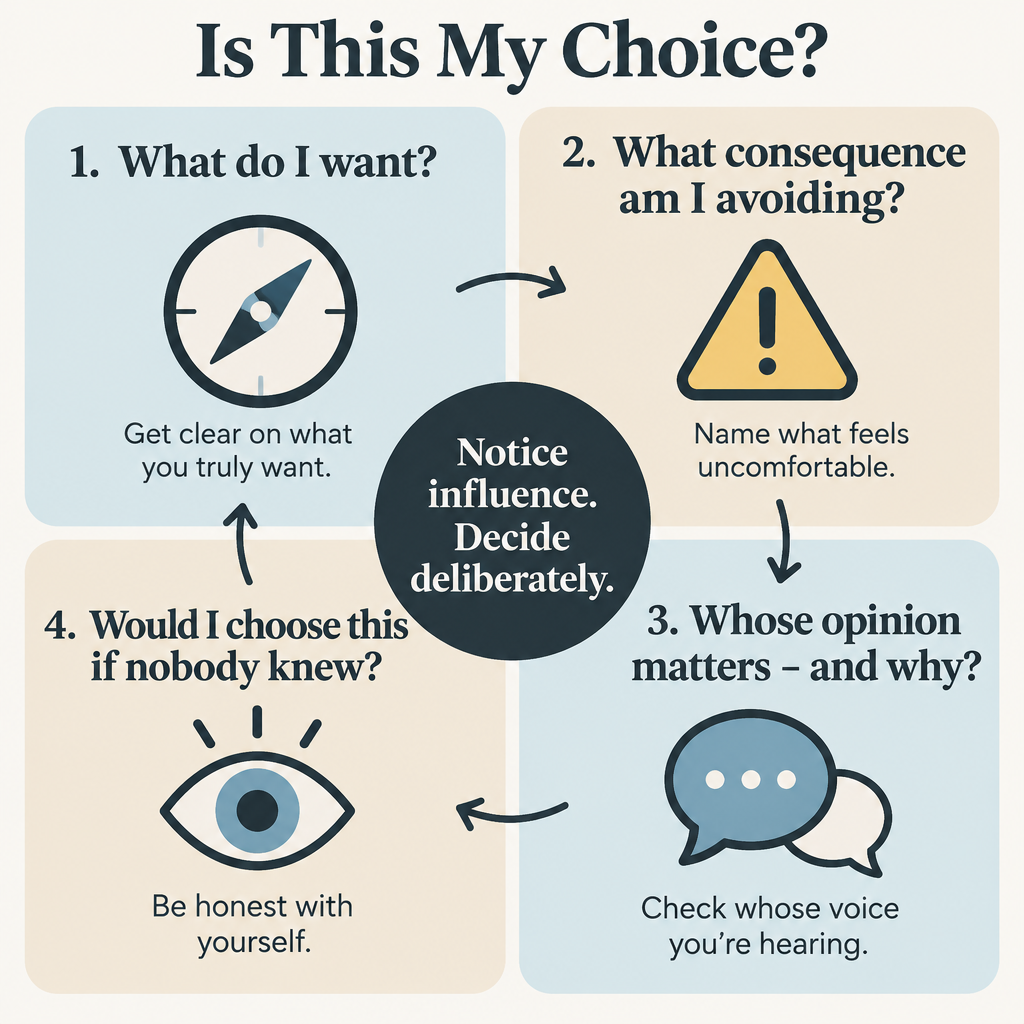
Use four questions before calling a choice your own
You do not need perfect certainty. A brief, honest check can reveal whether you are acting from preference, fear, duty, or some mixture of all three.
- What do I actually want? Describe the outcome in plain language. “I want to stay in my current city for two more years” is clearer than “I do not want to disappoint anyone.”
- What consequence am I trying to avoid? It may be conflict, financial strain, criticism, loneliness, or the feeling of being seen as selfish. Some consequences are manageable; some deserve serious planning.
- Whose opinion matters here, and why? A parent who depends on your care, a spouse affected by a joint financial decision, and a distant acquaintance do not have the same claim on the decision.
- Would I still choose this if nobody knew? This question does not settle everything, because relationships matter. But it can expose a choice driven mainly by appearances.
Look for the middle ground
Individual freedom does not require rejecting every inherited practice. You might choose to live with parents because the arrangement is loving and financially sensible. You might attend a religious or family ceremony because it is meaningful to you. You might keep some personal details private because privacy helps you feel safe and settled.
Those can all be freely made choices when there is room to reflect and when the decision is not maintained by threats, humiliation, or constant coercion. Similarly, choosing a different path is not necessarily a rejection of family. An adult may value their family deeply while declining an early marriage, changing careers, or living separately.
A hypothetical example
Suppose Maya is encouraged to take a secure job close to home rather than move for a new role. Her family may be thinking about stability, safety, and staying connected. Maya may be thinking about professional growth and independence. Neither side needs to be treated as selfish by default. The useful questions are practical: Can she afford the move? How will she stay in touch? Is there a safety plan? Does the new role genuinely fit her goals? Once these are answered, “What will people say?” should not become the only deciding factor.
Why disagreement can feel like control
Pressure often produces resistance. In psychology, reactance refers to the agitated motivational state that can arise when people perceive a threat to their freedom. A command such as “You must do this” can make even reasonable advice harder to hear. Research on reactance helps explain this response, but it does not mean every concern is controlling or every objection is wise.
Pause before reacting. Ask whether the other person is offering information, expressing a need, trying to manage their anxiety, or truly trying to remove your choice. These can overlap. You can protect your autonomy while still taking a legitimate concern seriously.
Respond without turning every choice into a fight
A respectful boundary is usually clearer than a long defence. You can acknowledge care without handing over the decision.
- Acknowledge the concern: “I understand that you are worried about stability.”
- State the decision plainly: “I have decided to apply for the role in another city.”
- Share only what you are comfortable sharing: “I have considered the costs and housing. I do not want to discuss every detail.”
- Repeat rather than debate endlessly: “I hear that you disagree. My decision remains the same.”
This approach will not guarantee approval. Its purpose is to keep you from confusing explanation with permission. It also leaves room for a real conversation when one is possible.
Freedom is shaped by real constraints
Choices are not made in a vacuum. Financial dependence, caregiving responsibilities, discrimination, immigration status, safety, health, and housing can narrow a person’s options. In such situations, freedom may mean building more room to choose over time: saving money, gaining skills, finding supportive people, collecting reliable information, or making a gradual plan. A dramatic break is not the only proof of independence.
The goal is not a life without influence. Everyone is shaped by family, culture, relationships, and circumstance. The goal is to notice that influence, weigh it fairly, and make decisions you can honestly stand behind—even when they are respectful continuations of tradition.
Sources
APA Dictionary of Psychology, “social norm”; scholarly reviews on social norms and reactance cited above.