
Hiding one small thing is not automatic proof of betrayal. What matters is what was hidden, why it was hidden, whether it has become a pattern, and how your partner responds when you ask about it.
A person can be honest and still have privacy. They do not owe a partner every passing thought, every message with a friend, or every detail of a private family conversation. But privacy stops being a healthy boundary when it is used to create a false picture of something that affects both people.
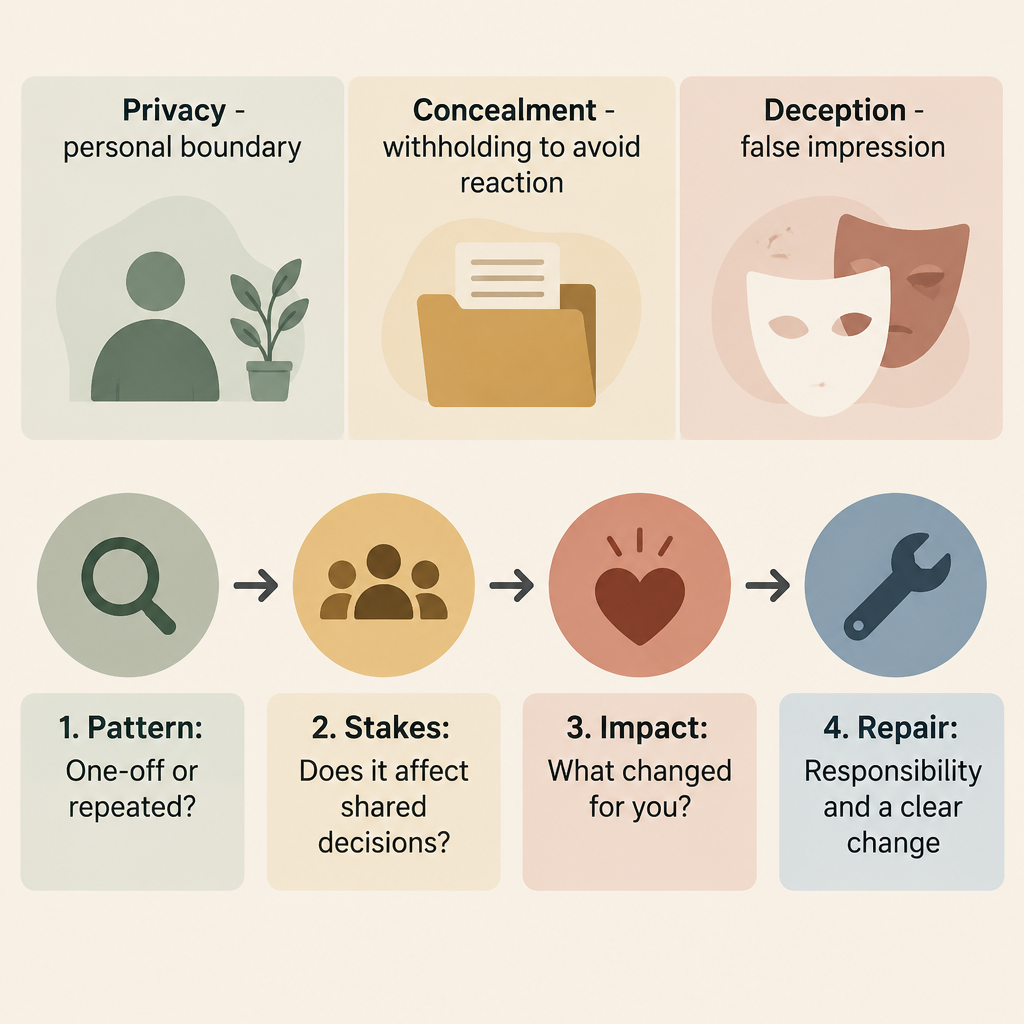
Privacy, concealment, and deception are not the same
| Term | What it means in practice |
|---|---|
| Privacy | Keeping some personal space without misleading the other person. For example, talking privately with a sibling about a family matter. |
| Concealment | Withholding information, often to avoid conflict, embarrassment, or consequences. For example, not mentioning an expensive purchase because you expect an argument. |
| Deception | Giving a false impression through a lie, a misleading answer, or a carefully edited story. For example, saying the purchase never happened. |
The difference is important. A couple can respect each other’s individuality without having total access to each other’s phones, thoughts, friendships, or history. At the same time, shared decisions need reliable information. Money, sexual health, fidelity, safety, parenting, major family commitments, and plans that affect the household are not merely private matters.
Small hidden matters can still feel large because they change your sense of what is real. Research on self-concealment in romantic relationships found associations between daily concealment and lower relationship satisfaction and commitment, as well as more conflict. That does not mean every private boundary is harmful; it does suggest that ongoing withholding can create distance. Read the study record on PubMed.
Why people hide seemingly small things
Sometimes the reason is fear rather than malice. A person may expect anger, feel ashamed, want to avoid disappointing someone, or have learned that disagreement leads to a long fight. Others hide things because they want more independence, do not know how to say no, or are avoiding a consequence.
Those motives can explain behaviour, but they do not make misleading someone harmless. “I did not want you to be upset” may be a genuine feeling. It can also shift attention away from the choice to hide the truth. The useful question is not only whether the motive sounds understandable. It is whether both partners can discuss difficult matters honestly and safely.
Not every lie has the same purpose. Diary research on everyday lies found that people reported fewer lies in interactions with people they felt close to, and that lies to friends were more often described as altruistic than lies to acquaintances or strangers. That is useful context, not a way to diagnose a particular partner’s intent. Read the study record on PubMed.
Use four questions before deciding what it means
- Pattern: Was this a one-off lapse, or do you keep finding omissions, altered details, and changing explanations?
- Stakes: Did it concern a harmless preference, or money, fidelity, health, safety, addiction, family obligations, or another shared decision?
- Impact: Did the information affect your choices, dignity, consent, finances, or ability to feel secure in the relationship?
- Repair: When it came up, did your partner tell the truth, listen to the impact, and make a specific change? Or did they minimise, blame, retaliate, or make you doubt what happened?
Consider a hypothetical example. Someone says they met an old colleague for coffee but leaves out that the colleague is an ex-partner. The coffee itself may not establish betrayal. Yet the omission matters because the missing detail may have changed how the other partner understood the situation. If the explanation is, “I knew you would overreact,” the couple may need to examine two issues: why honesty felt difficult and whether either person’s conflict style has made direct conversation feel unsafe or futile.
Repeated deception can create distance even before it is discovered. In research involving several studies, deception was associated with lower perceived social closeness; however, some of the evidence was correlational and one experiment involved strangers rather than established couples. It is best understood as a warning about connection, not a prediction of any one relationship’s future. Read the study record on PubMed.
How to raise the issue without interrogating
Choose a calm time rather than starting during an argument or immediately after a discovery. Focus on the specific behaviour. Broad claims such as “You always lie” invite a debate over the word always and make it easier to avoid the real concern.
- Describe what happened: “You told me the payment was for groceries, and later I learnt it was for a loan to your cousin.”
- Name the impact: “That made me feel excluded from a financial decision that affects us.”
- Ask an open question: “What made it hard to tell me directly?”
- State the need going forward: “I am not asking to know every private thought, but I need us not to mislead each other about things that affect our relationship.”
Then listen for an answer, not just an excuse. A useful conversation may reveal an avoidable misunderstanding, a fear of conflict, or a genuine mismatch in expectations about privacy. It may also reveal that the issue is more serious than it first appeared.
When firmer boundaries are needed
One uncomfortable conversation is different from a persistent pattern. Take repeated lying seriously, particularly when stories change, financial information is hidden, reasonable questions bring punishment or intimidation, or you are pressured to doubt your memory of clear events. Concealment that affects sexual health, safety, shared money, housing, parenting, or informed consent deserves direct attention rather than endless benefit-of-the-doubt calculations.
A boundary is not a demand to control another person. It is a clear statement of what you need in order to participate in the relationship. For example: “I cannot make joint financial plans if accounts or debts are hidden from me,” or “If you need private time with friends, I can respect that, but I will not accept being given a false explanation.” The other person remains free to choose; you remain free to decide what you can safely accept.
Look for repair, not perfect words
Repair is more than an apology. It usually includes acknowledging the specific deception, answering relevant questions without turning hostile, accepting the impact, and agreeing on a realistic change. For a money-related omission, that might mean discussing major spending before it happens. For conflict avoidance, it might mean pausing a difficult conversation and returning to it at an agreed time rather than hiding information.
Research on discovered deception has found that relationship-focused repair efforts were positively associated with trust, affection, and intimacy in participants’ reports. It cannot prove that repair will restore trust or that anyone should stay after being deceived. It does reinforce a practical point: what happens after the truth comes out matters. Read the study record on PubMed.
Trust does not require total access to another person’s life. It grows when both people can keep legitimate boundaries while being truthful about what materially affects the relationship. If small hidden things have become a pattern, do not rush to label every incident as betrayal. Ask for clarity, notice whether actions match words, and take your own need for honesty seriously.