
No. Keeping some parts of your life private from your parents is not automatically wrong, ungrateful, or dishonest. A close adult relationship can include love, contact, and mutual support without requiring one person to report every decision, feeling, or detail.
This can feel difficult when a family treats complete openness as proof of respect. An adult child may then feel guilty for not discussing a relationship, salary, health concern, belief, friendship, or daily routine. But growing up includes deciding what is personal, what affects other people, and what kind of help you actually want.
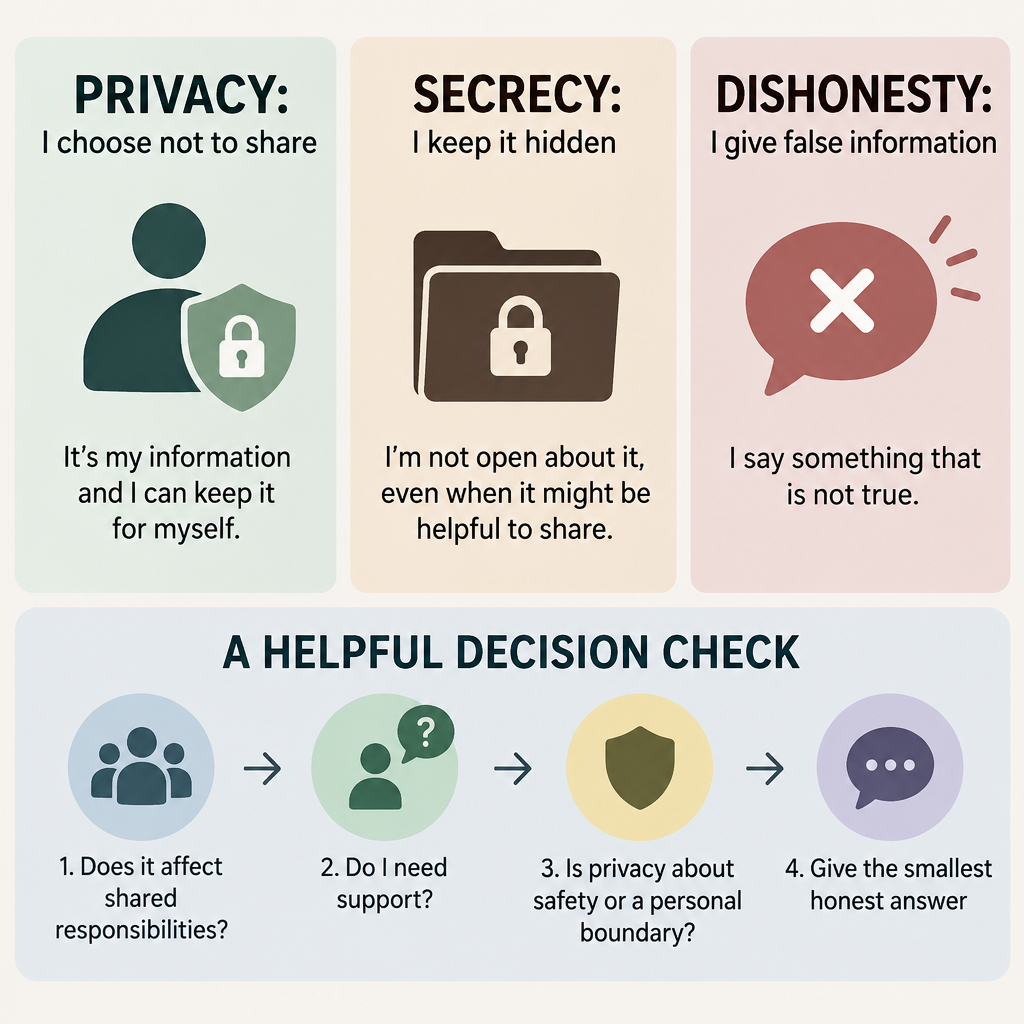
Privacy, secrecy, and dishonesty are not the same
These words are often used as if they mean the same thing. They do not.
- Privacy means choosing not to share personal information. “I am not ready to talk about my dating life” is a boundary.
- Secrecy means deliberately keeping something hidden, often because you expect a strong reaction. It can be reasonable in some circumstances, but it can also become exhausting.
- Dishonesty means giving false information. “I am not seeing anyone” when you are, or inventing where money went, is different from simply declining to discuss the subject.
The line can be complicated. Someone who depends on parents for housing may need to discuss a decision that changes the household. Someone facing anger, threats, or coercion may need to keep information private for their own safety. Context matters more than a simple rule about whether families should share everything.
Research on emerging adults has described withholding information from parents as boundary work: an attempt to protect autonomy while preserving the relationship. Participants described motives such as avoiding judgement, reducing parental worry, and keeping romantic or friendship matters personal. That does not make every secret wise, but it does challenge the idea that privacy always means rejection. Read the study record.
What parents usually do and do not need to know
A useful starting point is this: parents do not automatically have a right to every detail of an adult child’s inner life. They may have a legitimate reason to know about matters that directly affect shared responsibilities.
| Situation | A reasonable approach |
|---|---|
| A new friendship, private disagreement, or personal belief | You may keep it to yourself or share only what feels comfortable. |
| Dating or a possible marriage | You can choose the timing and level of detail, while considering whether the relationship will soon affect family plans. |
| Shared home, money, or caregiving | Share information that changes costs, routines, safety, or commitments for others. |
| A serious health or safety risk | Consider involving a trusted person, especially when practical support may be needed. |
| Fear of punishment, violence, or forced control | Prioritise safety, seek trusted local support, and do not assume disclosure is required. |
Use a simple decision test before you share
Before a difficult conversation, pause and ask four questions.
- Does this information directly affect my parents’ money, home, health, care responsibilities, or commitments?
- Am I asking for advice, practical help, or emotional support?
- Am I keeping this private because it is genuinely personal, or because I expect pressure, humiliation, or retaliation?
- If I do share, what is the smallest honest amount I am comfortable saying?
The fourth question is especially helpful. You do not have to choose between a full confession and a lie. A limited, truthful answer can protect both your dignity and the relationship.
For example, suppose an adult child is considering a career change. If they are not asking for money and the decision will not disrupt a shared household, they may say, “I am thinking through my next steps, but I do not want advice yet.” If parents are covering rent during the transition, the conversation should be more open because their financial planning is involved.
Say the boundary without making it a fight
A boundary works best when it is brief, clear, and not designed to win an argument. Long explanations often invite people to debate your reasons instead of hearing your limit.
- “I know you care about me, but I am not ready to discuss that.”
- “I will share if I need advice. Right now, I need to make this decision myself.”
- “I am safe. I would rather not go into the details.”
- “Please do not take my privacy as a lack of love.”
- “I understand that you disagree. I am not asking you to approve this decision.”
Then repeat the point if needed. A boundary is not a demand that the other person be pleased. It is a statement of what you will and will not discuss. If a conversation becomes insulting or coercive, it is reasonable to end it and return later, if at all.
Why concealment can become a warning sign
Privacy becomes harder to sustain when it turns every interaction into vigilance: changing stories, hiding ordinary messages, or living with constant fear of being found out. That strain may signal an unhealthy family dynamic, an unresolved practical obligation, or a decision that needs more careful thought.
It is also worth examining the fear itself. Some parents react badly because they are worried, used to being involved, or unfamiliar with an adult child making independent choices. Others respond with guilt, threats, surveillance, or attempts to control. These situations should not be treated as identical. A calm parent may be able to adjust over time; controlling behaviour may require firmer limits and outside support.
Research with parent–emerging adult child pairs suggests that parental overinvolvement does not necessarily reflect the adult child’s autonomy needs. That is one reason it helps to address a specific behaviour—repeated calls, demands for passwords, unwanted advice—rather than arguing about whether a parent loves or cares enough. Read the study abstract.
A note for parents
If you are a parent, curiosity is understandable. Yet the way you respond determines whether your adult child is likely to speak openly next time. Questions can communicate care; interrogation can communicate that privacy will be punished.
- Ask whether they want advice before giving it.
- Accept “not ready to discuss it” without treating it as disrespect.
- Explain practical concerns clearly when a decision affects shared finances, living arrangements, or care.
- Do not use guilt, comparisons, or threats to force closeness.
- Leave room for your adult child to make a choice you would not make.
Trust grows when people learn that honesty will be met with steadiness, not immediate judgement. That does not require parents to agree with every decision. It means disagreement does not have to become emotional punishment.
Connection does not require full access
A mature parent-child relationship makes room for two truths at once: family connection matters, and an adult child has a separate life. Share what affects others, what you need help with, and what you genuinely want to share. Keep personal what is yours to hold until you are ready.
The goal is not secrecy for its own sake. It is a relationship where privacy does not have to be defended as betrayal, and openness is offered freely rather than extracted through fear.