
Yes, you can forgive someone without trusting them again. You may decide that you no longer want anger, revenge, or an old injury to dominate your inner life. That does not require you to hand the person the same access to your time, private information, money, home, or emotions that they had before.
This distinction matters because people often hear forgiveness as a command to return to normal. It is not. Forgiveness, trust, and reconciliation can move at very different speeds. Sometimes they never arrive at the same place.
Four ideas that are easy to mix up
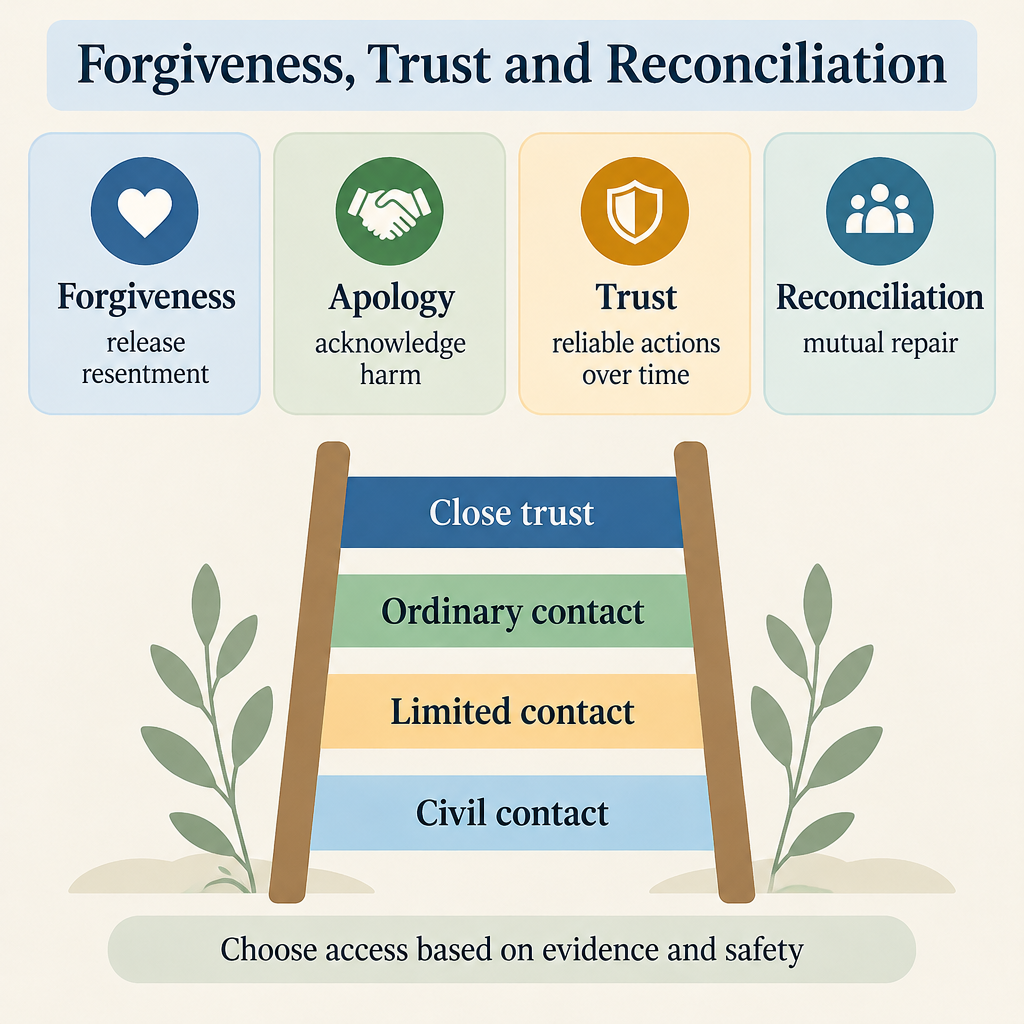
- Forgiveness
- An inner choice to reduce resentment or the desire to get even. It does not make the harm acceptable or erase its consequences.
- Apology
- The other person’s response to what happened. A meaningful apology names the harm and accepts responsibility; it is not simply a request to be forgiven.
- Trust
- Confidence that someone will act with honesty, care, and reliability in the future. It is built from evidence over time.
- Reconciliation
- A mutual rebuilding of a relationship. It requires participation from both people, not only the injured person’s willingness to let go.
A person may forgive a sibling for sharing a private matter, yet stop telling that sibling sensitive things. They may accept a friend’s apology and still decline to resume a close friendship. Neither choice is automatically cold or unforgiving. It can be a sensible response to what has been learned.
Family expectations, religious language, and social pressure can make this difficult. “Move on” may sound generous, but it can hide an unfair demand: that the harmed person restore closeness before they feel ready. Real forgiveness is voluntary. It is not proof that someone else has changed.
Why a quick apology is not the same as repaired trust
An apology can be an important beginning, especially when it is specific: “I lied about the money, and that put you in a difficult position.” But words tell you what a person understands in one moment. Trust depends on what they repeatedly do after that moment.
Relationship research similarly treats forgiveness and reconciliation as related but separate processes. Reconciliation concerns the repair of the relationship and depends on how both people respond after a wrongdoing, not on forgiveness alone. A scholarly review of post-transgression responses describes this as a process of rebuilding trust and shared relationship values, rather than a single decision.
What trustworthy repair tends to look like
- Clear acknowledgement: They describe what they did without making you argue for the facts.
- No excuses disguised as explanations: Context may matter, but it does not shift responsibility on to you.
- Changed behaviour: The same harmful pattern becomes less frequent and eventually stops.
- Respect for boundaries: They do not punish, mock, or pressure you for needing limits.
- Patience with consequences: They accept that trust may return slowly, partially, or not at all.
Consider a hypothetical couple in which one partner hid a debt. Saying sorry may be sincere, but financial trust is better rebuilt through transparent conversations, agreed spending limits, and consistent follow-through. The injured partner does not have to immediately share accounts, take on a new loan, or pretend there was no breach.
Or consider a friend who repeatedly shares confidences. You might forgive them enough to be polite at gatherings while deciding that private conversations are no longer safe. That is not an all-or-nothing verdict on their character. It is a boundary based on the actual pattern.
Use an access ladder instead of an all-or-nothing decision
Rather than asking, “Do I let them back in or cut them off forever?”, decide what level of access currently fits the evidence. You can revise that decision if their behaviour changes.
- Civil contact: Brief, respectful interaction where necessary.
- Limited contact: Occasional calls or meetings, with clear topics and time limits.
- Ordinary contact: A more regular relationship, while keeping some vulnerable areas protected.
- Close trust: Greater emotional, practical, or financial access earned through sustained reliability.
This approach is especially useful with relatives, where complete distance may be impractical or unwanted. You can attend a family event without discussing your relationship, finances, or personal plans. Courtesy is not consent to unlimited access.
Studies of romantic relationships have found links between forgiveness, lower negative conflict, greater relational effort, and relationship satisfaction. Those findings support a modest point: better relationship outcomes involve more than a private feeling of forgiveness; ongoing effort and conflict patterns matter too. They do not prove that any particular relationship should continue. Read the study on forgiveness and relationship satisfaction.
When reconciliation is not a wise goal
Reconciliation may be unsafe or deeply unhelpful when there is repeated betrayal, intimidation, manipulation, violence, coercive control, stalking, or ongoing refusal to respect boundaries. In such circumstances, distance may be the healthier choice. Forgiveness should never be demanded as proof of maturity, faith, kindness, or love.
If you are afraid of someone or feel pressured to stay in contact, focus first on immediate safety and support from trusted local people or appropriate professional services. A private decision to forgive, if it ever comes, is not a substitute for protection or support.
Let healing and trust keep their own pace
You do not need to decide the entire future of a relationship today. It may be enough to say, “I do not want to keep reliving this, but I need to see consistent change before I offer more trust.” That is both honest and fair.
Forgiveness-focused exercises may help some people reduce feelings of unforgiveness and distress, but they are a personal option, not a duty and not a reason to overlook danger. A short international trial of a self-directed forgiveness workbook reported improvements in unforgiveness, depression symptoms, and anxiety symptoms at a two-week follow-up; it did not show that reconciliation or restored trust is right for everyone. Read the trial record.
A useful question is: What would I need to see consistently before I gave this person more access to my life? Your answer might be accountability, honesty, months of changed behaviour, or simply more distance. Whatever it is, trust is allowed to be evidence-based.
Sources
- Forgiveness and Relationship Satisfaction: Mediating Mechanisms
- Downstream Consequences of Post-Transgression Responses: A Motive-Attribution Framework
- International REACH forgiveness intervention: a multisite randomised controlled trial