
You cannot guarantee that someone will not become defensive. They may be tired, ashamed, stressed, or already convinced that criticism means rejection. But you can greatly reduce unnecessary friction by raising one specific issue without attacking their character.
The most useful approach is simple: describe what happened, acknowledge their possible perspective where it is genuine, explain the impact on you, and ask for one concrete change. This is not about finding perfect words or pretending you are not upset. It is about making the real issue easier to hear.
Why ordinary complaints can sound like attacks
A complaint about an action can easily be heard as a verdict on the person: “You are selfish,” “You do not care about this family,” or “You cannot be trusted.” Once the conversation reaches that level, people often start defending their intentions, bringing up your faults, or arguing about details. The original problem gets lost.
That does not mean every hurt feeling is a misunderstanding. Sometimes a person has acted carelessly, unfairly, or repeatedly crossed a boundary. Still, language that separates the behaviour from the whole person gives a conversation a better chance of staying useful.
Research based on conflict scenarios found that openings framed with “I” language were rated as less likely to prompt defensiveness than “you” language. Statements that communicated both people’s perspectives were rated most favourably, though this does not mean careful wording will prevent a defensive response in every real-life conflict. Read the study on I-language and perspective-taking.
Use a four-part opening
- Name the moment: Describe one observable event, not a pattern you cannot prove.
- Acknowledge context: Briefly recognise their likely situation if you honestly can.
- Explain the impact: Say what the event meant or caused for you.
- Make one request: Ask for a practical change for next time.
Acknowledging context is not a ritual apology for bringing up the issue. It simply signals that you can see more than your own side. You might say, “I know you had a difficult day,” without adding, “So it was fine that you took your anger out on me.”
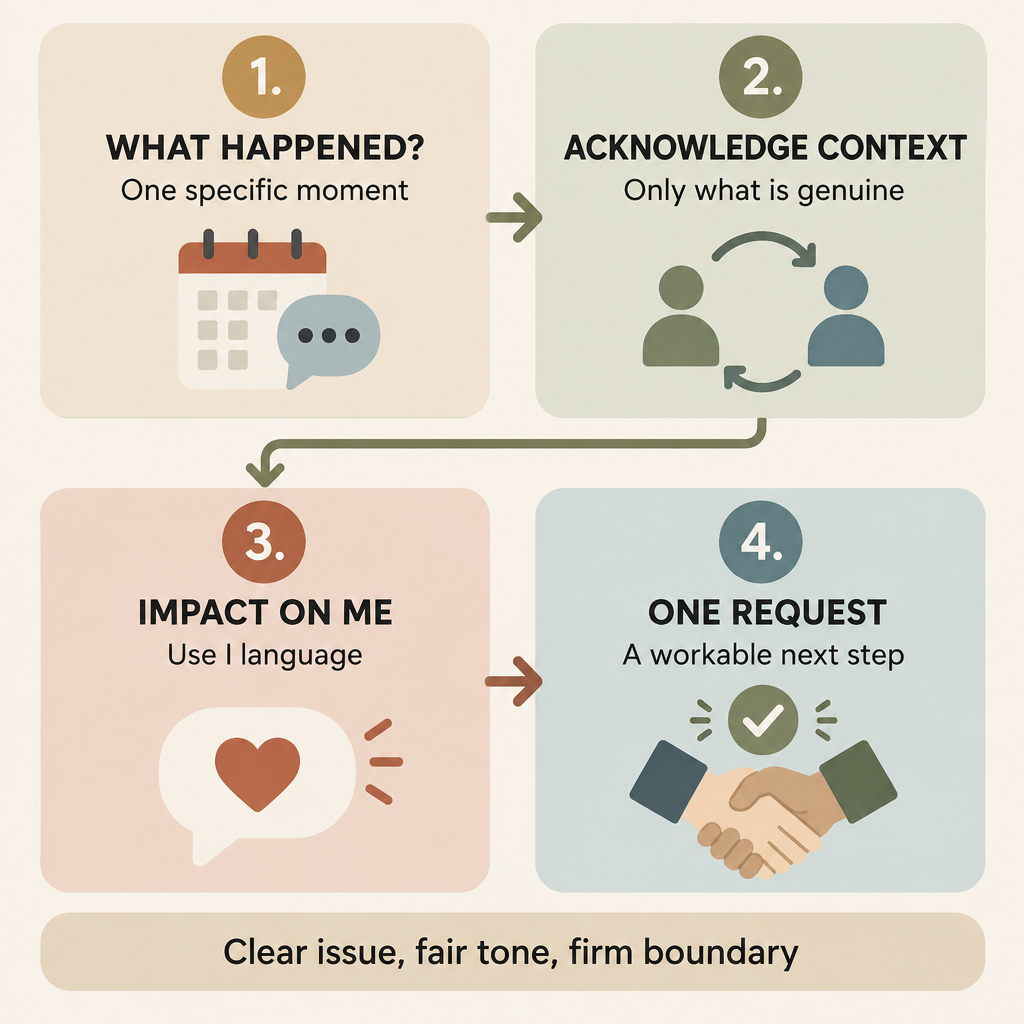
What the four parts sound like in real life
Compare these two ways of raising the same concern after guests visit the home.
| Likely to create a fight | Clearer and less accusatory |
|---|---|
| “You never care about this family. You left me to do everything alone.” | “I know you were tired after work. When I handled the visitors alone, I felt unsupported and overwhelmed. Can we decide beforehand how we will share this next time?” |
The second version does not hide the complaint. It identifies the moment, gives fair context, names the impact, and asks for a decision. It also avoids “never,” which invites the other person to search for one exception instead of considering what happened.
Here is another example, involving a friend who repeatedly cancels plans at the last minute: “When our plans changed an hour before we were meant to meet on Saturday, I felt disappointed because I had kept the evening free. Is something making it difficult to commit to plans lately? If so, could we make plans only when you are reasonably sure?”
The question matters. It leaves room for information you do not have: a family problem, money worries, health concerns, or a schedule that is genuinely unpredictable. It is not mind-reading. At the same time, the request protects your time.
Empathy is not surrender
People sometimes avoid direct conversations because they fear sounding harsh. Others believe that understanding someone’s reason means they must excuse the result. Neither is true.
- You can understand that a parent is worried about your future and still ask them not to criticise your choices in front of relatives.
- You can recognise that a spouse is under pressure and still insist that shouting is not acceptable.
- You can accept that a colleague made an honest mistake and still ask them to correct it.
Try using both halves of the truth: “I understand why you may have seen it that way, and I still need you to understand the effect it had on me.” This is especially helpful in families where respect is sometimes confused with silence. Respect can include speaking plainly without humiliating the other person.
Make the conversation easier to follow
- Choose the setting. Do not raise a sensitive issue in front of guests, children, or a group chat if a private conversation is possible.
- Discuss one issue. Bringing a long record of old failures may be understandable, but it usually creates a trial rather than a discussion.
- Speak about actions, not hidden motives. Say “You did not reply for three days,” rather than “You wanted to punish me.”
- State your purpose. “I want us to handle this better next time” is different from trying to prove that you are morally superior.
- Ask, then listen. A real question needs room for an answer you did not predict.
- Pause before escalation. If voices rise or either person cannot think clearly, agree to return at a specific time.
Making a constructive intention explicit may help when criticism is necessary. Experimental research on negative moral feedback found less defensive reception when a helpful intention was communicated, but the findings came from brief study situations and should not be treated as a guarantee in a strained family relationship. See the research on communicating helpful intentions during criticism.
What to do when they still become defensive
A good opening cannot make another person willing to engage. They may deny the event, change the subject, mock your feelings, or immediately reply with a complaint about you. In that moment, do not rush to explain yourself ten different ways.
Return to the point once: “We can talk about your concern too, but I want to finish this one first. I am asking that we agree on how to handle it next time.” If they continue to deflect, a limit is often more useful than a longer argument: “I am willing to discuss this when we can speak without insults. I am going to stop this conversation for now.”
Being heard is not the same as getting agreement. It means your words receive attention and respect rather than being dismissed or distorted. Research on feeling heard links it with greater openness to future conversation, while also making clear that it is a distinct experience rather than proof that a relationship problem has been solved. Read the research on what it means to feel heard.
A short repair checklist
- What happened, in one or two factual sentences?
- What impact did it have on me?
- What might the other person have been dealing with, if I genuinely know?
- What do I need now: an explanation, an apology, a boundary, or a changed plan?
- What is one workable next step?
Use this approach to create clarity, not to manage someone else’s emotions. The goal is not to sound endlessly gentle while your needs disappear. It is to be specific, fair, and firm enough that a reasonable person can understand both the problem and the path forward.
If a conversation includes intimidation, threats, coercive control, or fear of violence, better phrasing is not the main solution. Prioritise safety, seek support from trusted people or appropriate local services, and avoid confronting the person in ways that put you at greater risk.
Sources
- Research on I-language and communicating perspective during conflict.
- Research on communicating helpful intentions when giving criticism.
- Research on the experience of feeling heard in social relationships.