
You can talk about cultural differences respectfully without pretending they do not exist. The essential habit is simple: be curious about the individual in front of you, and cautious about what you assume their background means.
Culture can shape family life, food, language, faith, ideas about privacy, ways of showing respect, and how directly people communicate. But it does not work like a script that every person follows. Two siblings from the same home may hold very different views; people may follow some traditions closely, adapt others, or feel conflicted about them.
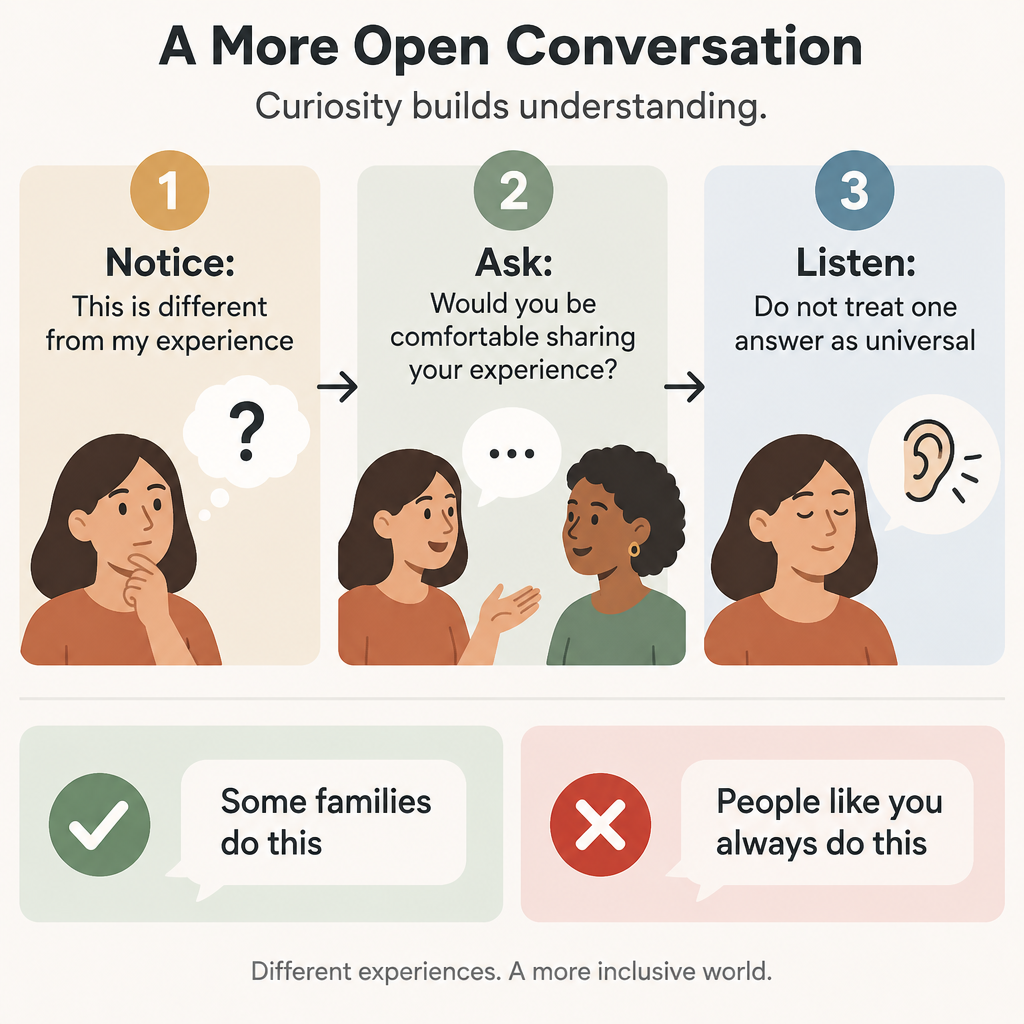
The difference between observation and stereotype is often in the wording. “Some families prefer adult children to live nearby” leaves room for variation. “People like you always live with their parents” turns a broad impression into a verdict about a person.
Noticing difference is not automatically disrespectful. In controlled research, focusing on self-other differences sometimes increased perspective-taking rather than making people less understanding. That is a useful reminder that the goal is not to erase difference, but to avoid filling gaps in knowledge with assumptions. The study’s findings come from experimental settings, so they are better treated as a prompt for humility than as a rule for every conversation.
Why these conversations can become tense
A question can feel personal when it touches identity, family pressure, discrimination, religion, or a practice someone has spent years explaining or defending. It may also be unclear whether the listener is genuinely interested or looking for evidence that their own way is better.
There is another complication: people often use the same behaviour for different reasons. Living with parents may reflect affection, financial practicality, caregiving, housing costs, duty, or simply preference. Avoiding open disagreement may be intended as politeness in one setting and may feel restrictive in another. The outward fact alone rarely tells the full story.
Begin with an invitation, not a conclusion
A respectful question gives the other person choice. It does not demand that they teach, defend, or speak for millions of people.
- “Would you be comfortable sharing how this works in your family?”
- “I have heard different approaches to this. What has your experience been?”
- “Is this important to you personally, or does it vary a lot?”
- “Please tell me if this is too personal to answer.”
These questions are not magic phrases. Tone and timing matter. A colleague at work may not want to discuss religion during a rushed meeting; a new friend may not want to explain a painful family conflict over dinner. Permission makes a conversation easier to decline, which makes agreement more meaningful.
Ask for a lived experience before a general explanation
“Why do people from your culture do that?” is a heavy question. It assumes the person agrees with the premise, knows a single answer, and is responsible for representing everyone. A better starting point is, “How was this understood in your home?”
For example, instead of asking why a community has arranged marriages, ask a friend whether family involvement was part of decisions in their own family, and what it meant to them. They may describe support, pressure, both, or neither. Their answer is information about their life, not a final explanation of a culture.
Describe differences without ranking them
Words such as “normal,” “strange,” “backward,” “modern,” or “civilised” often smuggle a judgement into a question. Try more precise language: “This is different from what I grew up with,” or “I am used to families handling this another way.” This locates your own point of view instead of presenting it as the universal standard.
It also helps to separate curiosity from approval. You can understand why a custom matters to someone without needing to adopt it. Likewise, someone can value their heritage and still question a family expectation. Respect is not agreement; it is the willingness to hear a person accurately before deciding what you think.
Listen for meaning, not only for facts
When someone describes a custom, listen for the value or concern beneath it. A rule about visiting elders may express care and interdependence. A preference for direct speech may express honesty. A preference for indirect speech may express consideration and social harmony. None of these meanings can be presumed; they need to be explored.
Perspective-taking can help, but it should not become guesswork. Research on perspective-taking and stereotyping has found that its effects can vary across cultural settings. This research is a reason to avoid treating any one communication technique as universally effective. Ask, listen, and let the person correct your interpretation.
Keep culture from becoming a shield against necessary questions
Cultural respect does not require silence about harm, consent, fairness, coercion, or personal boundaries. It is possible to say, “I understand this matters to your family, and I am still concerned that you do not feel free to choose.” That sentence recognises context without treating tradition as beyond discussion.
The same care applies in the other direction. Criticising a practice based on a viral video, one difficult encounter, or a second-hand story is not serious understanding. Ask what you do not know, and avoid using one example as proof of what an entire group is like.
Mistakes that close a conversation
- Making one person a spokesperson: “Explain why your people believe this.”
- Using social media as evidence: assuming a few posts reveal everyday life for a whole community.
- Hiding judgement behind honesty: “I am just being honest” does not make a sweeping claim fair.
- Confusing silence with agreement: someone may be tired, uncomfortable, cautious, or simply unsure how to respond.
- Assuming similarity means shared values: nationality, faith, language, or ancestry cannot tell you everything about a person.
How to repair an awkward comment
Most people will eventually say something clumsy. The repair matters more than the performance of being perfectly informed. Start by naming the problem plainly: “I realise I made an assumption there.” Do not immediately add a long explanation of what you meant; intent may matter, but it does not erase the impact of careless wording.
If the other person is willing, ask what you missed and listen without debating their reaction. Then adjust: use more specific language, stop pressing for an answer, or reconsider the belief that led to the comment. A short, sincere apology followed by changed behaviour is usually more useful than repeated self-criticism.
A better standard for cross-cultural conversation
Try to leave a conversation knowing more about a person, not merely feeling more certain about a group. Culture influences people, but it does not fully define their character, choices, or beliefs. That small distinction makes room for both honest difference and human dignity.
Research on actively considering another person’s psychological experience has found more positive outcomes in particular interracial experimental interactions. The evidence does not promise that empathy will solve every difficult exchange. It does support a sensible everyday practice: slow down, replace certainty with a question, and let the individual be more complex than the label.