
The pizza place near Malaz metro station always smells the same — charred dough, olive oil, and heat rising from the pavement. It’s not famous. Just one of those places people drift into after work, where construction dust settles on plastic chairs and the city keeps moving even while you sit still.
I was there on an ordinary evening, doing something ordinary: eating pizza and watching Riyadh stretch itself into the night.
That’s when I noticed her.
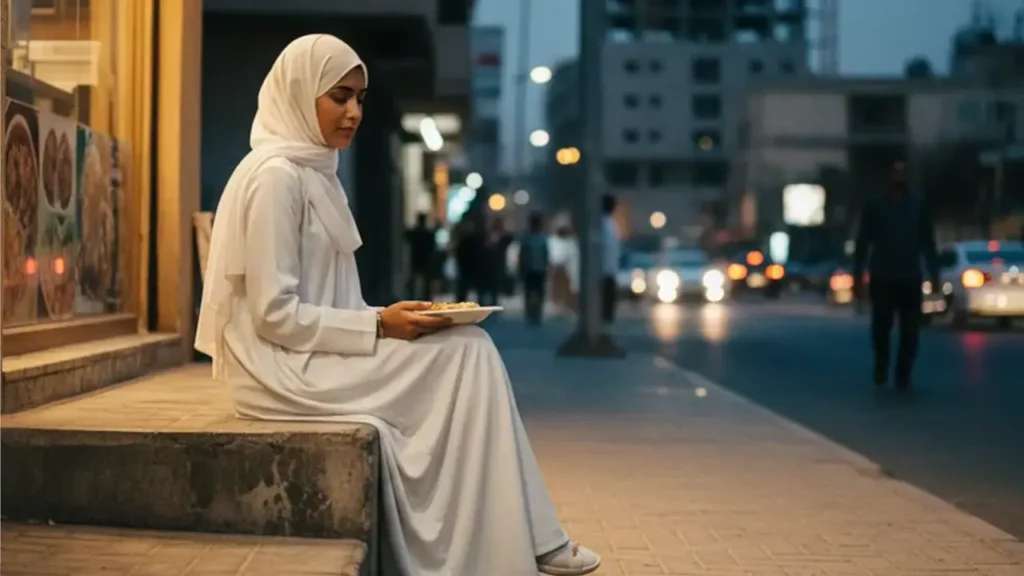
The first thing was the white hijab. Not the black that blends into the evening crowds, but white — clean, striking, almost glowing against the dust and concrete. She looked young, perhaps in her mid-twenties, and carried herself with a quiet composure that felt almost out of place in that busy strip of shops.
She wasn’t carrying anything.
But her eyes carried a lot.
A Small Question
She approached my table slowly, with a hesitation that suggested this wasn’t her first time asking. Her voice was soft, respectful, almost apologetic.
“Can you spare some food?”
It was such a simple question that my answer should have been simple too.
I opened the pizza box and offered her a slice — fresh, warm, untouched.
She gently shook her head.
“No,” she said kindly. “May I ask the shop owner instead?”
I watched her walk to the counter. The owner didn’t look surprised. He nodded, filled a plate, and handed it to her without a word. She stepped outside, sat on a low wall, and ate quietly in the fading light — alone, but not unseen.
That moment stayed with me long after my pizza was gone.
What Her Choice Meant
I realized later that she hadn’t refused food.
She had refused pity.
By asking the shop owner rather than accepting directly from me, she chose a form of exchange that allowed her to keep something of herself intact. It was subtle, almost invisible, but powerful. She wasn’t asking to be rescued — only to be acknowledged as someone navigating a difficult moment with care and restraint.
It made me think about how dignity often shows up in the smallest decisions, especially when choices are limited.
Order and Intention
Riyadh, like many global cities, faces real challenges with street begging. Authorities have emphasized the importance of public safety, organized charitable systems, and protecting people from exploitation by networks that profit from desperation. These concerns are serious, and addressing them is part of maintaining social order.
Official channels for assistance exist — structured, regulated, and designed to ensure that help reaches those who need it most.
And yet, standing there, watching a woman eat quietly on a low wall, I couldn’t help wondering how often life unfolds outside the neat lines of systems and policies.
The Questions, who was she?
Was she passing through a difficult phase? Was she someone who had slipped between the cracks of formal support? Was she simply hungry that evening, with nowhere else to turn?
Cities rarely tell us the full stories of the people we pass. We see moments, not histories. Outcomes, not journeys.
What struck me wasn’t just her situation — but how carefully she handled it.
Compassion, Carefully Held
In recent years, people have been encouraged to direct compassion through official avenues rather than individual gestures. The intention is understandable: to reduce exploitation, to ensure fairness, to prevent harm.
Still, moments like this raise quiet questions.
What does compassion look like when systems feel distant?
How do you respond, as a human being, when another human being is hungry in front of you?
There are no easy answers — only choices made in real time.
What Stayed with Me
I never saw her again. I don’t know where she went after that evening, or what her life looked like the next day. I only know the image that remains with me: a woman in a white hijab, choosing dignity in the only way available to her, eating quietly as the city moved on.
That refusal — the gentle, deliberate one — taught me something I didn’t expect.
Sometimes, people don’t ask for much.
Sometimes, what they protect most fiercely is not their hunger, but their self-respect.
And sometimes, the most powerful stories aren’t about solutions or policies — but about a single moment, shared briefly, before disappearing back into the rhythm of the city.
Expecting questions from the readers.