
A real apology is not just the word “sorry”. It is a clear signal that someone understands what they did, recognises its effect on you, and is willing to take responsibility and act differently. Even then, an apology is an opening for repair, not a requirement that you forgive quickly or trust again.
This distinction matters after a painful argument, broken promise, betrayal, or repeated disrespect. The person who caused the hurt may want relief from guilt. You may need clarity, safety, time, and evidence. Those are different needs.
Research suggests that apologies can encourage forgiveness partly by communicating that the relationship still has value. But that does not make an apology a reset button, especially after serious or repeated harm. Experimental research on apologies and relationship value also has important limits: it cannot tell someone what they must do in a complicated real-life relationship.
A useful way to judge an apology is to look beyond how emotional or polished it sounds. Ask whether it contains accountability, repair, and a pattern of change.
1. They name what they did clearly
A sincere apology identifies the action without making you do the work of explaining it again. “I am sorry I shared what you told me privately with others” is clearer than “I am sorry you felt hurt.”
The second statement may sound gentle, but it shifts attention towards your reaction. The first acknowledges an actual choice and leaves room for its impact: embarrassment, loss of privacy, or a feeling that your confidence was not safe.
2. They take responsibility without adding a hidden defence
Context can be useful. An explanation is not automatically an excuse. Someone may say, “I was stressed and reacted badly,” while still making it plain that stress did not justify the behaviour. The problem begins when context becomes a way to dilute responsibility.
- Accountability: “I should not have shouted at you. I chose to handle my frustration badly.”
- Blame-shifting: “I would not have shouted if you had not pushed me.”
- Minimising: “It was only a joke; you are making it too serious.”
- Self-centering: “I feel terrible, so please stop being upset with me.”
Notice that blame-shifting does not always sound cruel. It can appear as a long explanation, a comparison with somebody else’s worse behaviour, or a quick move towards your faults. A real apology stays with the person’s own conduct first.
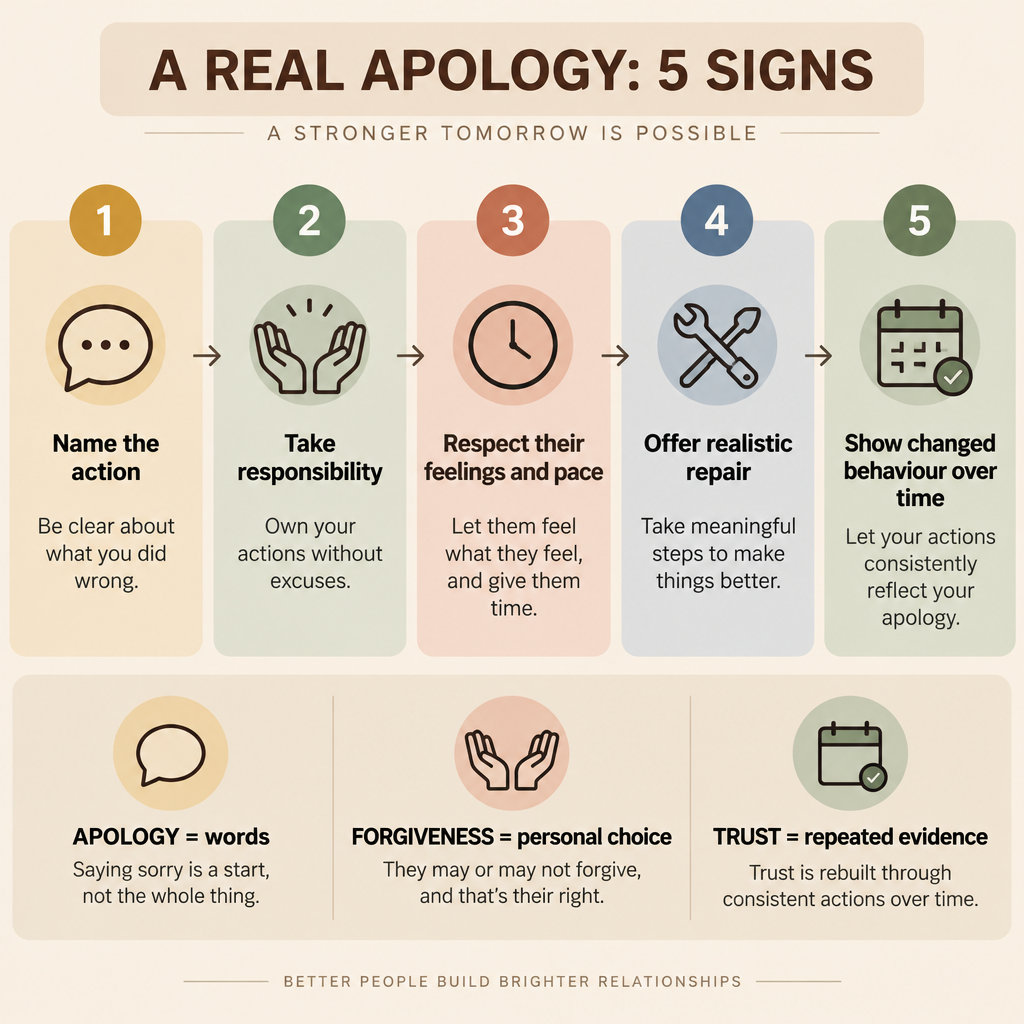
3. They make room for your feelings and your pace
An apology is easier to receive when it does not come with a deadline. You may appreciate it and still feel angry, cautious, sad, or unsure. You may need time before deciding whether you want further contact, a deeper conversation, or closeness again.
Pressure can make an apology feel like a request for emotional release rather than concern for the person harmed. “I apologised, what more do you want?” asks you to close the matter on the other person’s timetable. A more respectful response is, “I understand if you need time. I am here when you are ready to talk.”
You do not have to perform forgiveness to prove that you are kind, mature, or fair. It is reasonable to say, “I hear your apology. I am not ready to decide what this means for our relationship.”
4. They offer realistic repair
Words acknowledge harm; repair addresses its consequences where possible. Not every injury can be fixed, and no gesture can erase what happened. Still, a person who is serious about making amends usually asks what would help or suggests a practical next step without demanding credit for it.
| What happened | Possible repair |
|---|---|
| They repeated false information about you | Correct it with the people who heard it, without making you chase them. |
| They damaged or lost something of yours | Replace it, pay for repair, or agree on a fair alternative. |
| They crossed an agreed boundary | State the new boundary clearly and change the situation that made crossing it easy. |
| They concealed something that affected trust | Answer relevant questions honestly and agree on appropriate transparency going forward. |
Repair should fit the harm. Grand gifts, dramatic promises, or public displays may be less meaningful than the quiet, inconvenient action that puts things right. Research on forgiveness has found that an acknowledgement of wrongdoing and an offer of compensation can matter more than simply asking to be forgiven. This study of responses to wrongdoing accounts is a useful reminder that asking for forgiveness is not the same as earning it.
5. Their behaviour changes over time
Trust is not a prize you give because someone sounded sorry. It is a judgement you make from repeated evidence. If the same behaviour returns after every apology, the words may be sincere in the moment but insufficient for repair.
Look for change that is specific and observable. A friend who used to cancel plans without notice might communicate earlier and stop overpromising. A partner who dismissed your concerns might listen without interrupting, return to the topic later, and follow through on agreed changes. A relative who commented on your personal decisions might stop raising the subject after you set a boundary.
One good week is encouraging; it is not always enough to settle a long pattern. Trust often rebuilds gradually because it depends on whether someone is dependable when it is inconvenient, stressful, or unobserved. Laboratory research has found that apologies can improve perceived trustworthiness and later trusting behaviour after a violation, while also showing that negative emotions shape how an apology is received. Read the study on apology, trustworthiness, and emotion.
Apology, forgiveness, and trust are three different decisions
These ideas are often bundled together, which creates unnecessary pressure. They are separate decisions, and they may happen in a different order—or not at all.
- Accepting an apology can mean you acknowledge that it was offered. It does not promise reconciliation.
- Forgiveness may mean choosing not to hold on to revenge or constant resentment. It does not mean saying the harm was acceptable.
- Trust means deciding how much reliance, access, or vulnerability is safe to offer again.
You might accept an apology but need distance. You might forgive internally while choosing not to resume a close relationship. You might rebuild limited trust in one area while keeping firmer boundaries in another. Research on close relationships also treats post-harm trust as an important part of the path to forgiveness, rather than assuming the two are identical. See the research on post-transgression trust and forgiveness.
When an apology should not be the main focus
In situations involving coercion, threats, repeated manipulation, abuse, or a serious ongoing risk, the central question is not whether the apology sounds convincing. It is whether you are safe and supported. Keeping distance, documenting what is needed, speaking with trusted people, or seeking local professional and emergency support may be more important than having one more conversation.
Repeated apologies followed by the same harmful pattern deserve attention. A person may feel genuine regret and still be unable or unwilling to change. Your compassion for their struggle does not require you to keep accepting the same cost.
A short reflection checklist
- What exactly are they taking responsibility for?
- Did they acknowledge the impact on me without arguing with it?
- Are they offering a repair that fits the harm?
- Have they respected my need for time, space, or boundaries?
- What specific behaviour would I need to see before I trusted them more?
- Have I seen that behaviour consistently, especially when it takes effort?
A meaningful apology can be the beginning of a better relationship, but only when it is matched by patient repair and different choices. You are allowed to listen with an open mind while keeping your judgement open too.