
Parental advice becomes interference when it stops being an offer and starts becoming a demand. A parent may genuinely want to protect an adult child from disappointment, financial trouble, an unsuitable relationship, or a decision they may regret. But care does not give anyone the right to take over another adult’s choices.
The difference is often visible in what happens after the advice is given. Support leaves room for a different decision. Interference repeats the point, monitors the choice, recruits other relatives, withdraws warmth, or makes help conditional on obedience.
This does not mean parents must agree with every decision, or that adult children must dismiss family wisdom. Families can disagree about careers, marriage, money, religion, where to live, or how often to visit and still remain close. The important question is whether both people can recognise that the adult child has the final say over their own life.
Why advice can feel so personal
Advice is rarely only about the topic at hand. A parent may hear, “I will decide for myself,” as rejection or ingratitude. An adult child may hear, “You should do this,” as “I do not trust your judgment.” Old family roles can make these reactions stronger: the parent is used to guiding, and the child is used to being guided.
Disagreement alone is not proof that a family relationship is unhealthy. In a study of adult children and parents, tension was common; tensions about the relationship itself, such as feeling criticised or intruded upon, were more closely linked with lower closeness and mixed feelings than disagreements about individual issues. The study’s findings are a useful reminder to address the pattern of interaction, not simply win the argument.
Context matters too. A suggestion about saving money may feel useful when it is requested. The same suggestion may feel humiliating after it has been repeated for months or raised in front of relatives.
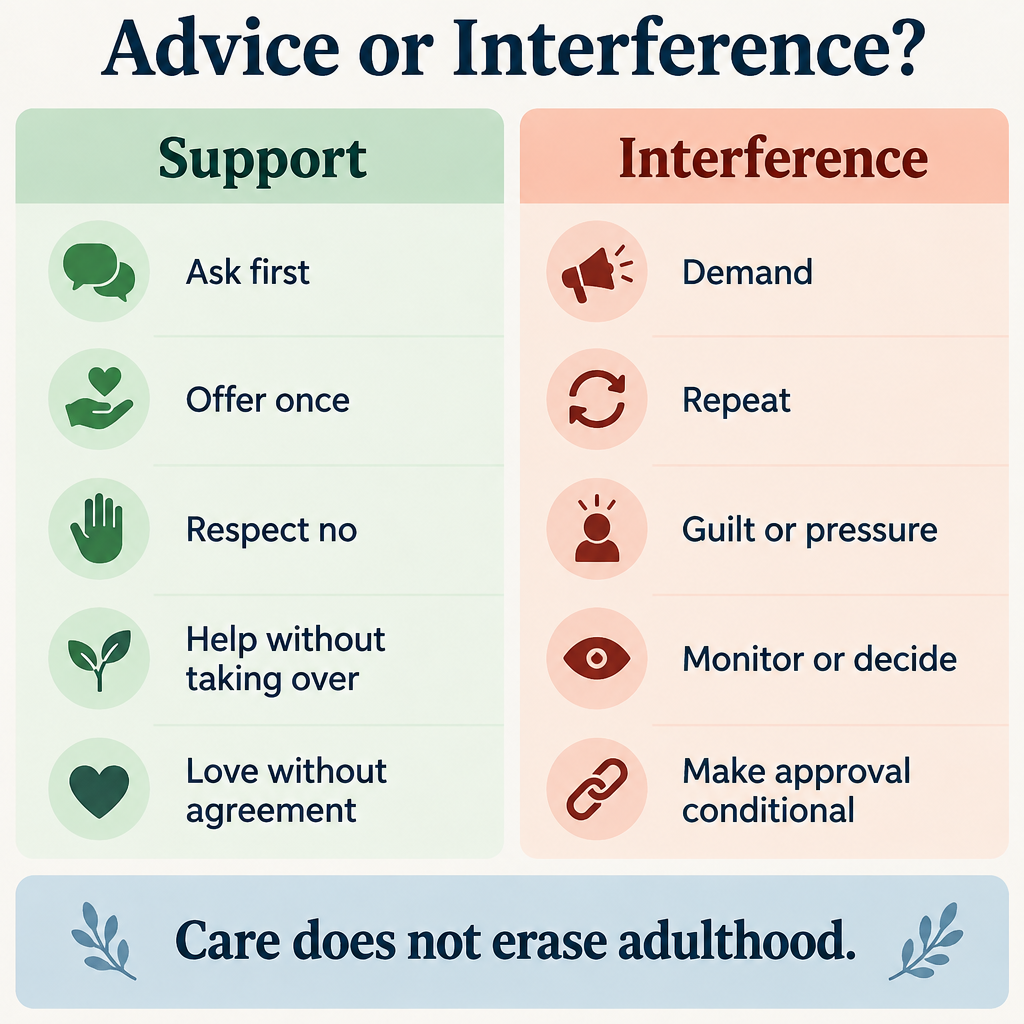
Support and interference: the practical difference
| Supportive involvement | Interfering involvement |
|---|---|
| Asks whether advice is wanted | Gives instructions without asking |
| States a concern once or clearly explains it | Repeats, lectures, or turns every conversation back to the issue |
| Accepts that the adult child may choose differently | Treats disagreement as disrespect or disloyalty |
| Offers help without taking control | Monitors, investigates, or makes decisions on the person’s behalf |
| Separates love from agreement | Uses guilt, threats, money, or family pressure to force compliance |
Consider a hypothetical example. A parent says, “I worry that this job offer has a long commute. Would you like to talk through the pros and cons?” That is an invitation. If the adult child accepts the job, the parent may still disagree, but can say, “I hope it works out, and I am here if you need help thinking through the move.”
It becomes interference when the parent calls daily to argue, contacts the employer without permission, tells extended family to persuade the child, or says, “After all we have done for you, you cannot do this to us.” The concern may be real. The method removes dignity and choice.
Why repeating advice usually makes things worse
People are more able to consider advice when they feel respected. Repeated unsolicited advice can instead make them defend themselves, hide information, or avoid contact. A seven-day diary study of US adults aged 18 to 30 found that advice was more likely to be experienced as unwanted in more strained parent-child relationships, and unwanted advice was associated with more negative mood that day. Read the study abstract. This does not prove that advice alone caused the mood, but it shows why relationship quality and permission matter.
Parents may also confuse urgency with usefulness. Fear about a child’s future can make immediate action feel necessary. Yet an adult child may need time to learn, make an imperfect choice, or reach a conclusion that differs from the family’s preference. Good intentions do not automatically make intense involvement helpful.
A boundary script for adult children
A boundary works best when it is clear, brief, and followed consistently. It is not an attempt to make the other person agree. It explains what you will and will not discuss or accept.
- Acknowledge the intention: “I know you are concerned because you care about me.”
- State the decision or limit: “I have decided to handle this myself.”
- Name useful support: “I would welcome help comparing rental options, but not comments about whether I should move.”
- Repeat rather than litigate: “I understand you see it differently. My decision is unchanged.”
- Act on the boundary if needed: “If this comes up again today, I am going to end the call and speak another time.”
The tone matters, but so does follow-through. Long explanations may invite a new round of debate. A calm, respectful repetition is often more effective than trying to prove that every concern is unreasonable.
A better approach for parents
Parents do not have to become silent or pretend not to care. A more respectful approach starts with consent: “Would you like my thoughts, or would you prefer that I listen?” This small question changes advice from a takeover into a conversation.
- Ask one clear question before giving an opinion.
- Share your concern in first-person language: “I worry about the cost,” rather than “You are being irresponsible.”
- Offer practical, limited help: a lift, a contact, childcare, a meal, or help reviewing options.
- Say what you hope for, then leave space for a different choice.
- Keep affection steady even when you disagree.
It can also help to ask, “What would feel supportive from me right now?” The answer may be advice, practical assistance, or simply a patient listener. Listening is not approval; it is recognition that an adult child is entitled to be heard.
When boundaries are more complicated
Independence looks different across families. An adult may live with parents, contribute to a shared household, rely on family money during a difficult period, provide care to an older parent, or belong to a culture where family decisions are naturally discussed together. These realities create legitimate shared concerns about budgets, guests, caregiving, safety, and household rules.
Shared responsibility is not the same as unlimited authority. A useful distinction is to separate decisions that affect everyone from decisions that primarily belong to one person. A household budget may require a joint conversation. An adult’s career, friendships, or relationship choices still deserve privacy and respect, even if relatives have strong views.
If conversations regularly include insults, threats, intimidation, financial punishment, or fear, a simple communication script may not be enough. Creating distance, seeking support from a trusted person, or speaking with a qualified counsellor may be safer and more appropriate.
The goal is respect, not distance
A close adult parent-child relationship does not require constant agreement. It requires room for both care and autonomy: parents can remain loving without directing every outcome, and adult children can value their parents without handing over their decisions. The healthiest version of advice is an open door, not a command.
Sources
- Research on tension, closeness, and ambivalence in adult parent-child relationships.
- Research on adult children’s daily experiences of parental advice and relationship context.