
A full stop can feel cold in a text because readers use tiny writing choices to guess the tone that voice, facial expression, and body language would normally provide. “Fine.” may look final or irritated even when the sender simply writes carefully. That feeling is real, but it is not reliable proof that the person is angry, distant, or disrespectful.
Texting asks us to interpret a lot from very little. A short reply may reflect a busy day, a small screen, a person’s usual style, or limited emotional energy. It may also signal annoyance. The challenge is that the message alone often cannot tell you which explanation is correct.
Why short messages carry so much emotional weight
In a face-to-face conversation, a calm voice can soften a blunt sentence. A smile can make “okay” reassuring rather than dismissive. If something lands badly, the other person can immediately say, “No, I did not mean it that way.” Text removes many of these repair tools. The reader is left to supply the missing tone.
That gap is especially uncomfortable when the relationship matters or the topic already feels tense. A delayed reply after an argument, a one-word response from a parent, or a formal message from a partner can invite anxious interpretation. People often read the message through the mood they were already carrying into the conversation.
Research on text-message formatting supports the basic point: readers can infer emotions such as frustration from periods placed after each word and from separate one-word messages. The findings show how text-specific patterns can stand in for spoken pauses and emphasis; they do not mean that ordinary punctuation is automatically rude. Read. This. Slowly: mimicking spoken pauses in text messages
A full stop is not the whole story
The same “Okay.” can be perfectly neutral from one person and noticeably sharp from another. Meaning depends on the pattern around it: the relationship, the recent conversation, the platform, and each person’s ordinary habits. Someone who uses full stops in every message is unlikely to be making a special point. Someone who normally writes warmly and suddenly sends “Fine.” may be communicating a change in mood—or may simply be rushed.
Age, culture, language background, and workplace norms matter too. Some people see punctuation as basic clarity. Others associate a bare full stop in a casual chat with finality. Neither habit is inherently more considerate. Trouble begins when one person treats their own reading habit as the only possible meaning.
Why effort can affect how a message is received
Readers also notice apparent effort. In an important exchange, “k” can feel different from “Okay, I understand.” The difference is not just the number of letters. The longer version gives the reader context and acknowledges what was said.
That does not make abbreviations bad. They can be natural shorthand between close friends and in fast-moving group chats. Yet research has found that abbreviations may make a sender seem less sincere in some messaging situations, partly because they can be seen as lower effort. Context remains important: a familiar shared style can change the meaning entirely. Shortcuts to Insincerity: Texting Abbreviations Seem Insincere and Not Worth Answering
Pause before deciding a text is cold
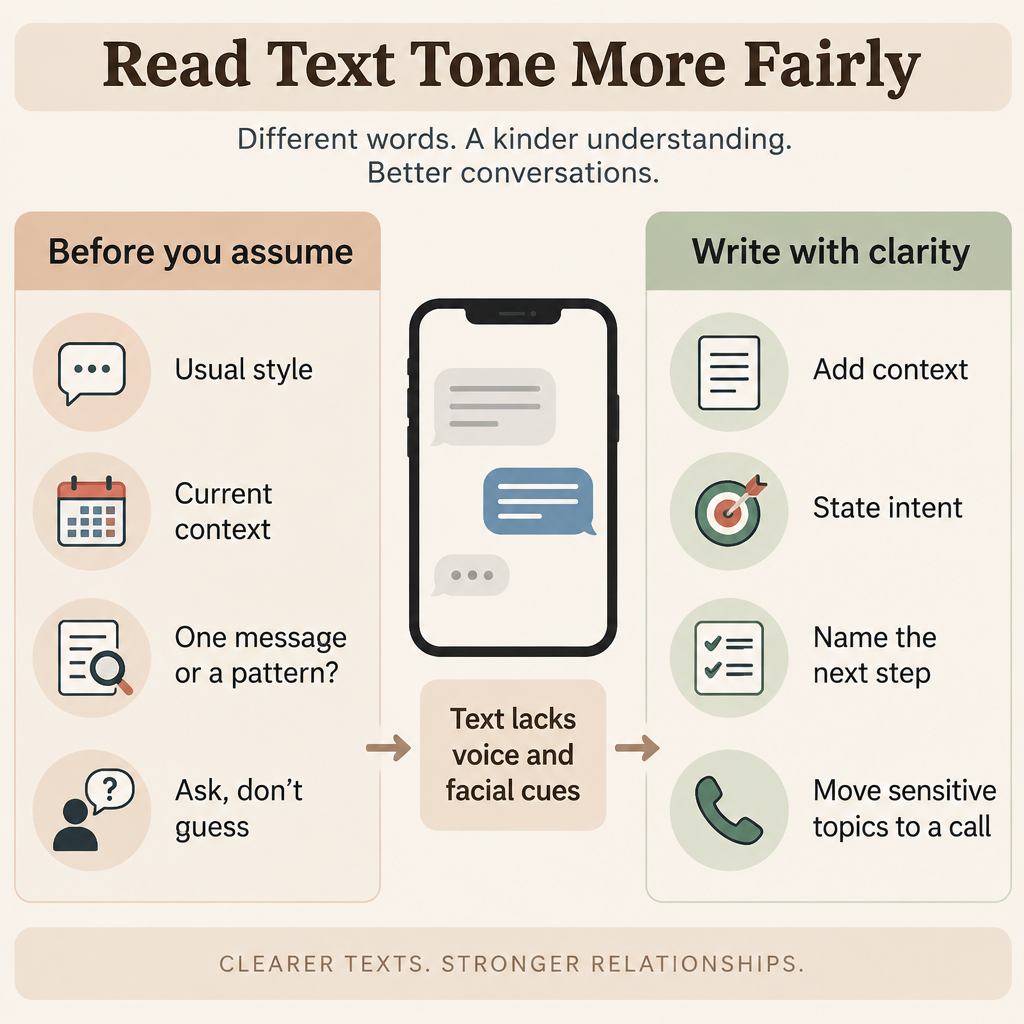
When a message stings, do not force yourself to ignore the feeling. Instead, separate the feeling from the conclusion. “This sounded abrupt to me” is an observation about your experience. “They do not care about me” is a much bigger claim that may not be supported by one reply.
- Compare it with their normal style. Do they usually write in short, practical sentences?
- Read the immediate context. Were they at work, travelling, caring for someone, or in the middle of another task?
- Notice the stakes. A reply about dinner needs less decoding than one about trust, money, or a relationship decision.
- Look for a pattern, not one mark. Consistent avoidance or contempt deserves attention; one brief message may not.
- Ask a simple question if needed. “You seem a little quiet—are we okay?” is clearer than replying with accusation.
This approach matters because people can both understand something about another person’s feelings and still project their own expectations onto an ambiguous message. A study of couples communicating by smartphone messenger found evidence of both empathic accuracy and projection bias. In plain terms, familiarity can help us read a person, but it does not make our interpretation infallible. Messenger-based assessment of empathic accuracy in couples’ smartphone communication
Write for warmth when the relationship matters
You do not need to fill every text with emojis, exclamation marks, or long explanations. The aim is not to perform cheerfulness. It is to add enough context that a reasonable reader is less likely to mistake brevity for hostility.
| Message that may feel closed off | Warmer, clearer alternative |
|---|---|
| Fine. | I’m fine, just tired. Can we talk later? |
| Okay | Okay, I understand. Let’s discuss it this evening. |
| Can’t talk. | I can’t talk right now, but I’ll message you after work. |
| Do what you want. | I’m upset and need some time before I can discuss this properly. |
These are not scripts to copy word for word. They illustrate a useful habit: name the practical reason, the emotional state, or the next step. A few extra words can prevent the other person from filling silence with the worst interpretation.
When text is the wrong channel
Some conversations are too emotionally loaded for a string of short messages. If you need to apologise, raise a painful concern, discuss a major decision, or resolve an escalating misunderstanding, suggest a call or an in-person conversation when it is safe and practical. A richer channel gives both people more cues and more chances to correct a misunderstanding before it hardens into resentment.
If a call is not possible, state your intention directly: “I’m not angry; I’m trying to be brief because I’m in a meeting,” or “I want to answer this thoughtfully, so I’ll reply later.” Directness can feel less elegant than hinting, but it is usually kinder than leaving the other person to guess.
A better rule than policing punctuation
Good digital communication is not about banning full stops or demanding instant replies. It is about holding two ideas at once: wording can affect people, and a single ambiguous text rarely tells the whole truth about someone’s intentions.
When reading, give the other person room for an ordinary explanation before assuming rejection. When writing, give the reader a little context when the subject is sensitive. That combination—less guessing, more clarity—makes texting feel more human.