
“I should have known better” rarely helps because it judges a past decision using information that became clear only afterwards. It turns regret into a verdict on your character: careless, weak, foolish, or irresponsible. That judgement may feel like accountability, but it often leaves you replaying the event rather than preparing differently for the next one.
A mistake can become useful information, but it does not automatically make a person wiser. Research on beliefs about failure found that people tend to overestimate how reliably failure leads to later improvement. Learning needs an extra step: deliberately connecting a past outcome to a specific future action. The Exaggerated Benefits of Failure
The most useful question is not “Why was I so stupid?” It is: “What would make a similar moment go differently?” That question does not erase responsibility. It makes responsibility actionable.
Regret is a comparison, not a complete story
Regret arises when the mind compares what happened with an imagined better alternative. You may regret an action, such as sending an angry message, or an inaction, such as not asking an important question before accepting a job. Either kind can hurt because the alternative feels vivid and the present outcome is real.
But the imagined alternative is usually simplified. It contains the one choice that would have fixed everything, not the uncertainty, pressure, limited information, or competing needs present at the time. Recent research on regret found that thoughts about imagined alternatives contributed more to regret than self-blame, and that having a justification for a decision reduced regret. Investigating the conditional effects of action versus inaction decisions on regret
This does not mean every decision was reasonable or every outcome unavoidable. It means an honest review needs two timeframes: what is known now, and what was reasonably visible then. Mixing them creates hindsight bias—the feeling that the warning signs were obvious all along.
How self-criticism keeps the lesson vague
After a painful outcome, it is tempting to create a large personal rule: “I cannot trust anyone,” “I always ruin things,” or “I will never make that mistake again.” These statements offer an illusion of safety. They are also too broad to guide a real decision.
Vague self-criticism creates three problems. It reduces a complicated event to a label about the self. It asks for certainty in situations where certainty is impossible. And it gives no small behaviour to practise when the pressure returns.
- Self-punishment: “I was foolish to lend the money.”
- Useful learning: “Before lending money, I will decide the amount I can afford not to recover and put the repayment terms in writing.”
The second response may still include sadness or anger. It simply turns the experience into a boundary that can be used.
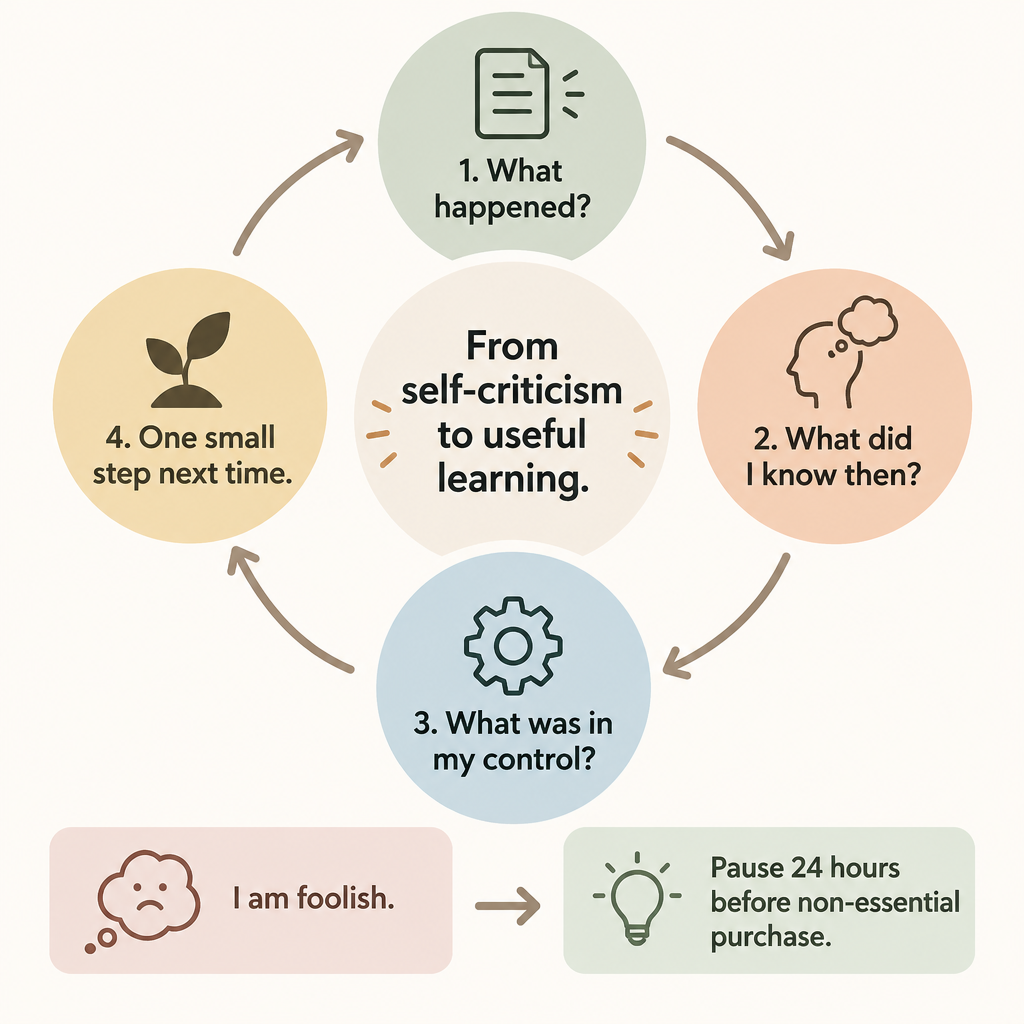
Use a four-question mistake review
Do this once you are calm enough to be fair to yourself and to anyone affected. Write short answers. The purpose is not to build a perfect explanation; it is to find one sensible adjustment.
- What happened? Describe observable events without insults or diagnosis. “I agreed to the purchase after a ten-minute sales call” is clearer than “I was manipulated.”
- What did I know at the time? Include pressures, assumptions, missing facts, and reasons for your choice. This separates hindsight from the actual decision.
- What part was within my control? Name your choice, preparation, words, or follow-up. Do not take responsibility for another adult’s dishonesty, reaction, or behaviour.
- What is one small step I will try next time? Choose a rule, question, boundary, or preparation step that is concrete enough to remember.
Turn the lesson into a next-step experiment
Grand promises usually fail because they demand a new personality. A next-step experiment asks for one repeatable action in a familiar situation. It is a better test of learning than declaring that you will never again be naive, angry, avoidant, or impulsive.
| Situation | Unhelpful conclusion | Small experiment for next time |
|---|---|---|
| You lent money to a relative and repayment became awkward. | “I should never help family.” | Pause for 24 hours, set a maximum amount, and discuss repayment before sending money. |
| You stayed silent during an argument and resentment grew. | “I always let people walk over me.” | Say, “I need time to think, but I want to return to this tonight.” |
| You ignored an early concern at work. | “My judgement cannot be trusted.” | Write the concern, the evidence, and one question to raise in the next meeting. |
| You made a rushed purchase. | “I am terrible with money.” | For non-essential purchases above your chosen limit, wait one day and compare two options. |
These are illustrative examples, not universal rules. A 24-hour pause may be impractical for an urgent need, and a written agreement may not suit every family relationship. The point is to make the adjustment proportionate to the risk and realistic for your life.
Review reasons without making excuses
Looking at your reasons at the time is not the same as excusing harm. Perhaps you were tired, worried about disappointing someone, under financial pressure, or trying to avoid conflict. Those conditions explain why a choice felt possible. They do not necessarily make it right.
This distinction matters when someone else was hurt. Accountability may mean admitting what happened plainly, apologising without demanding quick forgiveness, repairing a practical loss where possible, and changing the behaviour that led to the harm. Endless self-punishment is not a substitute for any of these things.
Regret is also an ordinary part of daily decision-making, not proof that a person is unusually flawed. An eight-day diary study found that people experienced and anticipated regret in everyday choices and used decision-specific ways of managing the feeling. Regulation of experienced and anticipated regret in daily decision making
When the lesson is not fully under your control
Some regrets concern outcomes no amount of planning could guarantee: another person changed, an opportunity disappeared, illness intervened, or two important values conflicted. In these cases, the lesson may be about how to make a more informed choice, not how to ensure a better result.
For example, ending a relationship may still feel painful even if it was the safest or healthiest choice available. The lesson might be, “Next time, I will speak about this concern earlier,” rather than, “If I say the right thing, the relationship will definitely work.” A good review respects uncertainty.
A short check before you move on
- Can I describe the event without calling myself names?
- Have I separated what I knew then from what I learned later?
- Have I identified my responsibility without taking ownership of everything?
- Is my next step specific enough to use under stress?
- If another person was harmed, is there a repair or apology I can make?
If regret becomes persistent and is accompanied by hopelessness, severe anxiety, sleep disruption, or difficulty functioning in daily life, it may be worth speaking with a qualified mental-health professional. A mistake review is a reflection tool, not a replacement for support when distress is overwhelming.
You do not need to pretend a mistake was good in order to learn from it. You only need to stop asking it to prove that you are a bad person. A painful decision becomes more useful when it leaves you with one honest sentence about the past and one practical choice for the future.