
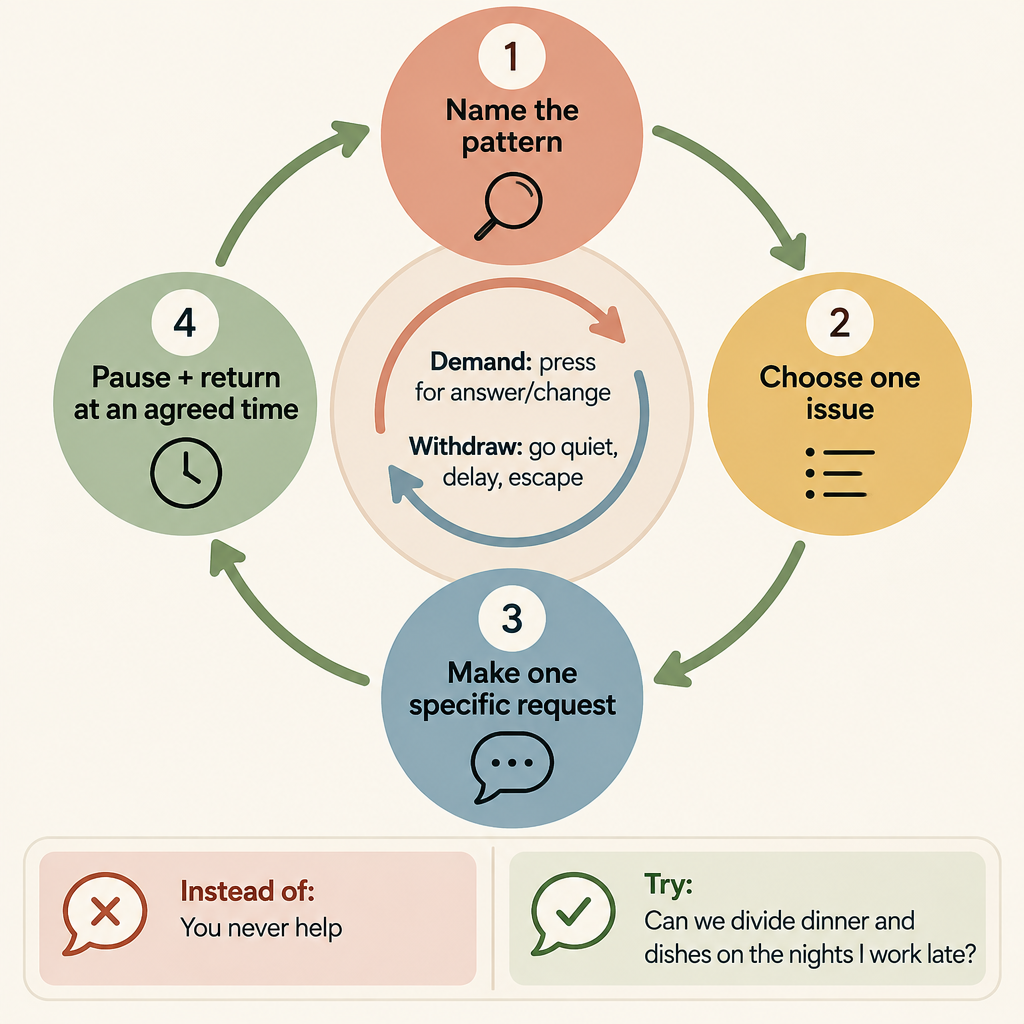
When married couples keep having the same argument, the problem is often not simply that one person refuses to listen. They may be caught in a repeating pattern: one partner pursues a discussion, answer, or change, while the other goes quiet, delays, changes the subject, or leaves. The more one presses, the more the other withdraws. Then both feel alone in the marriage.
This is commonly called a demand-withdraw cycle. It can happen in any gender pairing and does not automatically mean either spouse is the villain. In diary research with married US couples, both husband-demand/wife-withdraw and wife-demand/husband-withdraw patterns appeared in everyday conflict; couples who reported less of this pattern also reported higher marital satisfaction. Read the study.
Consider a familiar example. One spouse says, “You never help at home. I have asked you a hundred times.” The other hears criticism, feels that nothing they say will be enough, and retreats into silence or says, “Not now.” The first spouse takes that silence as proof that they do not care and pushes harder. The original question—how to share the work—gets lost.
The way out is not to avoid every disagreement. Some differences about money, family boundaries, intimacy, work, or household responsibilities may remain partly unresolved. The aim is to stop treating each other as the problem, discuss one practical issue at a time, and return after a pause rather than abandoning the conversation.
How the cycle feeds itself
The pursuing partner is usually trying to restore connection, fairness, or certainty. The withdrawing partner is often trying to reduce emotional overload, avoid saying something hurtful, or escape a conversation that feels impossible to get right. Those motives do not make hurtful behaviour acceptable, but they explain why better wording alone may not immediately solve the conflict.
Stress can make this loop tighter. Work pressure, financial worries, caregiving, poor sleep, and conflict with relatives can leave both people with less patience and attention. Longitudinal research has linked declining problem-solving effectiveness with lower relationship satisfaction among spouses facing chronically high cumulative stress. See the research on stress and communication. Stress is context, not an excuse for contempt, intimidation, or neglect.
Signs you are arguing about the pattern, not the issue
- The conversation begins with one topic and quickly becomes a list of past failures.
- Words such as “always,” “never,” “lazy,” or “selfish” replace a description of what happened.
- One spouse demands an immediate answer while the other shuts down, scrolls, leaves, or repeatedly says “fine.”
- The same evidence is presented again because neither person feels understood.
- A practical request turns into a debate about character, intentions, or who is more hurt.
Spotting these signs is not about keeping score. It gives you a chance to name the loop before it gains speed: “We are doing the chase-and-shut-down thing again. Can we slow this down and deal with one part of it?”
A practical reset for a repeating argument
- Name the pattern without blame. Say what is happening between you, not what is wrong with your spouse. For example: “When I keep asking and you go quiet, I become more upset. I do not want us to handle it this way.”
- Choose one issue. Do not combine dinner, in-laws, spending, and last month’s argument. Pick the immediate question.
- Describe an observable need. Replace conclusions about motive with facts and impact: “I have cooked every night this week and I am exhausted.”
- Make one specific request. Ask for an action that can be accepted, declined, or adjusted: “Can we decide who handles dinner on the three nights I work late?”
- Use shared language where it is genuine. “How can we make evenings easier?” may invite collaboration better than “What are you going to do about this?” It is not a way to hide responsibility when one person has clearly caused harm.
- Plan a pause if either person is flooded. Agree on when you will return: “I need 30 minutes to calm down. Let us talk at 8:30.”
Specificity matters. In a study of couple conversations, more specific change requests and requests framed with “we” were associated with better problem resolution, while “you” requests were more often followed by resistance in several analyses. This is a useful communication clue, not a magic sentence or a guarantee. Read the study of change requests.
Turn accusations into workable requests
| When the conversation sounds like this | Try making the need more concrete |
|---|---|
| “You never help me.” | “Can we divide dinner and dishes on the nights I work late?” |
| “Your family controls everything.” | “Before we agree to weekend plans with family, can we speak privately first?” |
| “You do not care about money.” | “Can we review this month’s expenses for 20 minutes on Sunday?” |
| “You never spend time with me.” | “Can we keep one hour after dinner on Friday free from phones and chores?” |
These examples do not require a spouse to agree. They make a real answer possible. A partner can suggest a different evening, a different division of work, or a limit they can realistically meet. That is far more useful than defending themselves against “never.”
A pause should have a return time
A break is helpful when it lowers the temperature and is followed by a return to the issue. It becomes damaging when it is used to punish, frighten, or make the other person chase indefinitely. Before pausing, state three things: that you are pausing rather than refusing the topic, roughly how long you need, and when you will come back.
During the break, do something that genuinely settles your body and attention: walk, shower, breathe slowly, write down the one point you need to make, or sit quietly. Do not use the interval to collect ammunition. Research on romantic partners has found an association between better recovery after conflict and more positive relationship emotions and satisfaction, which is one reason the recovery phase deserves attention. Read the post-conflict recovery study.
Repair is more than saying sorry
After a hard conversation, repair begins by acknowledging the impact. “I was sarcastic, and I can see that embarrassed you,” is more useful than “Sorry, but you started it.” Then return to the practical question. If the issue was shared household work, make the plan. If it was a boundary with relatives, agree on what each person will say and do next time.
An apology can open a door, but follow-through builds trust. If one spouse agrees to take responsibility for school pickups twice a week, remembering the arrangement matters. If a couple agrees not to discuss sensitive matters in front of relatives, both need to protect that boundary. Small, repeated actions are often what make a new pattern believable.
Discuss the pressure behind the argument
Sometimes couples are fighting about dishes when the deeper strain is an ageing parent’s care, a demanding job, debt, grief, illness, or the feeling that there is no private time left. Try asking, “What has been weighing on you lately that I may be missing?” This does not erase the original concern. It may reveal why both of you have had so little room to handle it well.
If conversations stay stuck despite sincere attempts, a qualified couples counsellor may help create structure for difficult topics. Both partners need willingness to participate honestly for joint work to be useful.
When communication advice is not enough
This approach is not appropriate when one person is afraid of the other or when arguments involve threats, humiliation, violence, sexual coercion, constant surveillance, financial control, or isolation from friends and family. In those situations, do not treat the problem as a mutual communication style to be fixed together. Prioritise immediate safety and seek confidential support from local domestic-abuse services, emergency services, or a trusted person who can help make a safe plan.
A recurring argument does not have to become the permanent language of a marriage. Start smaller than you think: identify the loop, make one clear request, take a planned pause when needed, and come back to one decision. Respect is not the absence of disagreement; it is the way two people handle disagreement without making each other the enemy.