
You can miss someone deeply and still not send a message. Feelings and actions do not always move together. A person may care, remember, and long for closeness while also fearing rejection, reopening an old wound, or creating a situation they do not know how to handle.
This matters because silence is easy to interpret. The person waiting may conclude, “They do not care.” The person staying quiet may tell themselves, “It is better not to disturb them.” Either conclusion can be incomplete. Silence can signal indifference, but it can also signal caution, shame, grief, uncertainty, or a habit of keeping emotions private.
Space and avoidance are not the same thing
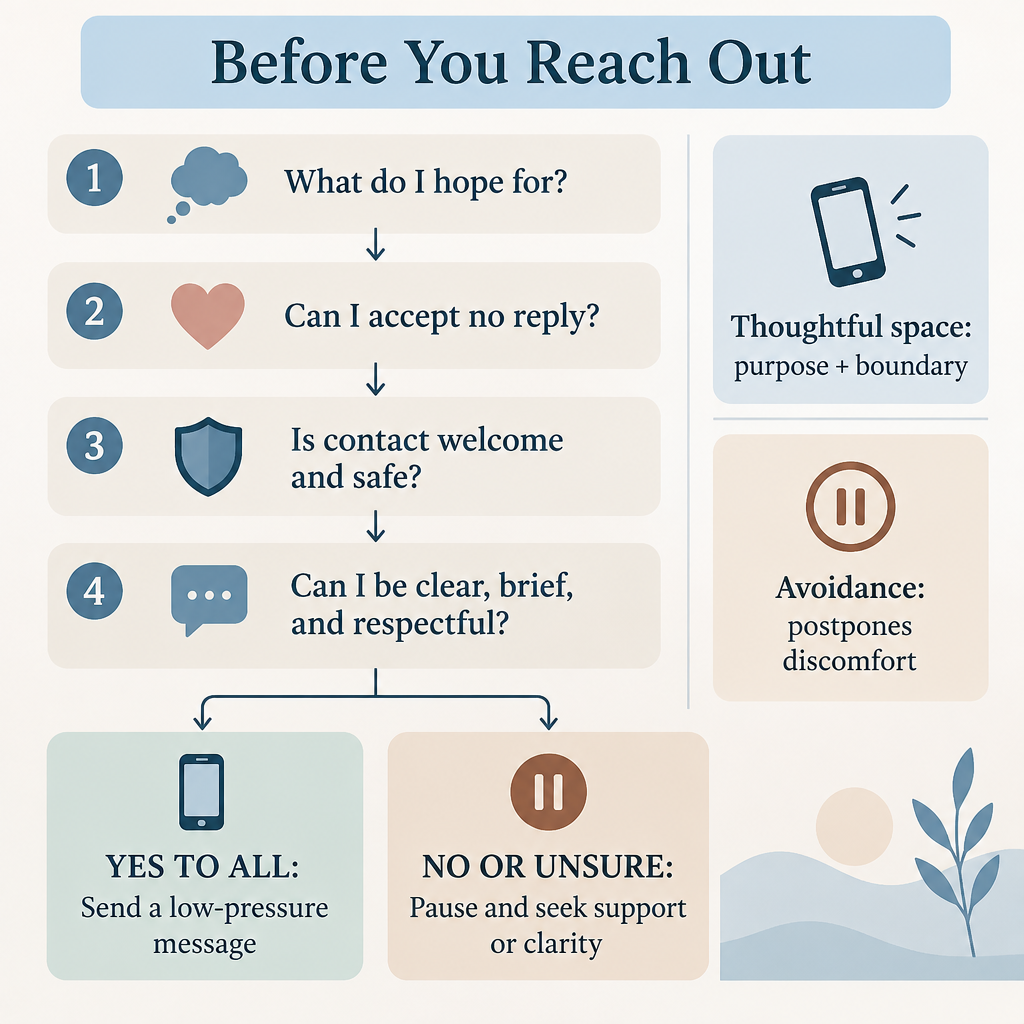
Healthy space has a purpose. Perhaps you need time to calm down after an argument, decide what you want, or respect a request for distance. It usually has some inner clarity: “I will revisit this after I have settled,” or “I will not contact them because they asked for no contact.”
Avoidance is different. It mainly postpones an uncomfortable feeling or conversation. You may draft a message repeatedly, check their profile, replay old conversations, and still do nothing because taking any step feels risky. The temporary relief is real, but the uncertainty remains.
Holding emotions back can also affect how connected people feel. Research on close relationships has found associations between greater day-to-day emotional suppression and more distancing, lower perceived acceptance, and lower relationship satisfaction. These findings do not mean that every quiet person is uncaring or that expression solves every problem; they do suggest that unshared feelings can have social costs. PubMed: suppression and expression in daily interactions
The useful question is not simply, “Why have I not reached out?” Ask instead: “Am I taking thoughtful space, or am I letting fear make the decision for me?”
Why reaching out can feel harder than missing someone
- Fear of rejection: A message creates the possibility of no reply, a brief reply, or an answer you do not want. Missing someone privately can feel safer than receiving a clear refusal.
- Fear of reopening pain: Contact may bring back a breakup, betrayal, family conflict, or a friendship that ended badly. The mind may treat silence as protection.
- Shame after conflict: If you said something hurtful, disappeared, or failed to show up, you may feel that you have lost the right to contact them. Shame often says, “Stay away,” even when a sincere repair may be possible.
- Unclear boundaries: You may not know whether they welcome contact, whether they are in a new relationship, or whether an old pattern would begin again.
- Learned emotional restraint: Some people grew up in settings where direct affection, apologies, or vulnerable conversations felt unsafe, embarrassing, or unnecessary. They may feel strongly but struggle to show it.
None of these explanations automatically makes silence kind or harmless. The other person cannot respond to needs, regret, or affection they cannot see. In a laboratory study of dating couples, people who reported suppressing emotion during conversations also reported lower conversation quality and connectedness. The study does not apply neatly to every relationship or text message, but it is a useful reminder that hiding everything may protect you in the moment while making connection harder. PubMed: spontaneous suppression in dating couples
Do not turn silence into a personality diagnosis
It is tempting to label a quiet person as emotionally unavailable, proud, manipulative, or detached. Sometimes a repeated pattern of disappearing, refusing accountability, or using silence to control another person does need to be taken seriously. But one period of distance cannot tell you everything about someone’s character.
The opposite mistake is also common: treating a strong urge to reconnect as proof that a relationship should restart. Longing can be about love, but it can also be about familiarity, loneliness, unfinished questions, or the wish to undo a painful ending. Missing a person does not erase the reasons distance became necessary.
A self-check before you send a message
- Name your hope. Are you offering an apology, checking in, seeking closure, rebuilding a friendship, or hoping to resume a relationship? You do not need certainty, but honesty prevents a vague message from carrying a hidden demand.
- Make room for every response. Can you cope with a warm reply, a polite boundary, no reply, or a refusal? If not, wait until you have more support and steadiness.
- Check whether contact is welcome and safe. Respect a request for no contact. Do not reach out where there has been abuse, coercion, stalking, or a pattern of boundary violations. Safety and consent come before closure.
- Choose one manageable action. A short, clear message is usually better than a dramatic confession sent in the middle of the night.
- Release the outcome. Reaching out can be an honest action; it cannot make another person forgive, explain, or reconnect.
If you are unsure, write the message in your notes first. Read it the next day and remove anything that pressures the other person to reassure you, explain themselves, or respond immediately.
How to reach out without putting pressure on someone
For an appropriate and safe situation, aim for a message that is brief, specific, and easy to decline. It should acknowledge the distance without making the recipient responsible for your feelings.
- “I have been thinking of you and hope you are doing well. No pressure to reply; I just wanted to say hello.”
- “I have reflected on our last conversation. I am sorry for the way I spoke to you. You do not need to respond, but I wanted to take responsibility.”
- “I miss our friendship and would be open to talking if that feels right for you. If not, I will respect that.”
These are not scripts for every situation. An apology should name the behaviour when appropriate rather than staying vague. A check-in should not be used to reopen access to someone who has clearly asked for distance. And if you are hoping to reconnect after a breakup, it is fairer to say so gently than to disguise the intention as a casual message.
When not reaching out may be the healthier choice
Do not contact someone simply to relieve your own discomfort if doing so would disrupt their recovery or violate a boundary. Step back when there has been repeated disrespect, intimidation, coercion, abuse, or a clear no-contact request. Also pause when a conflict is escalating and you cannot communicate without blame, threats, or emotional pressure. In high-conflict family or partner situations, support from a qualified local mental-health or domestic-violence service may be more appropriate than trying to solve everything through one message.
There is also a middle path: you can acknowledge the longing without acting on it. Talk to a trusted person, write an unsent letter, notice what the relationship represented, and make choices that support your present life. Feelings deserve attention, but they do not always require contact.
Emotional maturity is not forcing yourself to reach out, and it is not pretending you do not care. It is recognising what you feel, checking what the situation truly allows, and choosing an action that respects both people. Sometimes that action is a simple message. Sometimes it is a quiet boundary. Either can be an act of self-respect.